Category: Academic

  • Recognising the History and Legacy of Dr Elizabeth Blackwell (1821 – 1910):  A Trailblazing Female Physician 

    Recognising the History and Legacy of Dr Elizabeth Blackwell (1821 – 1910):  A Trailblazing Female Physician 

    Zahra Mohsin, Second Year Medicine

    Elizabeth Blackwell made history as the first woman in America to receive a medical degree, (Michals, 2015), as well as the first to have their name entered in the British General Medical Council’s Register in 1859, (University of Bristol, n.d.). Yet despite being a pioneer for women in the medical field, many may be unaware of the contributions which Dr Elizabeth Blackwell made towards promoting rights of women and their education in the medical profession.

    Blackwell was born in Bristol, England on February 3, 1821, the third of nine children to Samuel Blackwell, wealthy owner of a sugar refinery, and his wife Hannah Lane, (Michals, 2015). Although unusual for the era, her father insisted that Blackwell and her siblings be equally well educated, (BBC, 2008), resulting in her receiving an excellent education provided by private tutors, (WAMS, n.d.). In 1832, the family emigrated from Bristol to New York after the failure of her father’s business, moving again a few years later to Cincinnati, Ohio, (Michals, 2015). Blackwell’s father died in 1838, leaving his family in financial hardship and, following his death, she and her sisters took to teaching and opened a private school to support their family, (University of Bristol, n.d.).

    During her mid-20s, a close companion passed away from a prolonged illness, and prior to her passing, she had confided in Blackwell that her suffering would have been lessened had she been treated by a female doctor, (WAMS, n.d.). Following this, Blackwell decided to devote her career to studying medicine and ensuring that women received high quality healthcare. She began studying medicine privately for a few years before seeking admission to medical school, (Thakur et al., 2024). After several rejections, she was admitted to Geneva Medical College after the faculty, assuming they would not allow for a female to be enrolled, permitted the all-male student body to vote on her admission. As a joke, the student body voted “yes,” and Blackwell subsequently became a medical student, (University of Bristol, n.d.).  

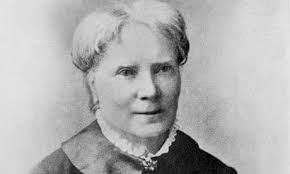
    Elizabeth Blackwell (Library of Congress, 1877)

    Blackwell faced discrimination and hostility throughout her time at medical school, including being forced to sit separately during lectures and often being excluded from labs, (Michals, 2015). Despite these odds, she continued to persevere, ultimately ranking first in her class in 1849, (The Editors of Encyclopedia Britannica, n.d.). 

    In the same year, Blackwell travelled to Paris where she studied midwifery at La Maternité. Here she contracted a serious eye infection whilst attending to a newborn, resulting in her becoming blind in one eye and ultimately compelling her to abandon hopes of becoming a surgeon, (Thakur et al., 2024). She later returned to England and worked under Dr, (later Sir), James Paget at St Bartholomew’s Hospital, (The Editors of Encyclopedia Britannica, n.d.). She became increasingly interested in social causes, particularly regarding the education of women, (Luft, n.d.). In the summer of 1851, she went back to the United States where prejudice against female physicians made practising medicine difficult, as she was refused posts and was unable to rent private consulting quarters, (The Editors of Encyclopedia Britannica, n.d.). Despite it taking a long time to develop her private practice, Blackwell opened a small dispensary in a slum district in New York in 1853, later being joined by her younger sister, Dr Emily Blackwell, and by Dr Marie E. Zakrzewska (The Editors of Encyclopedia Britannica, n.d.). In 1857, the dispensary was incorporated as the New York Infirmary for Women and Children. This was a healthcare facility dedicated to providing accessible healthcare for underserved populations, whilst also serving as a professional environment for female physicians, medical students, and nursing scholars (Thakur et al., 2024). 

    During a year-long lecture tour of Great Britain, Blackwell became the first woman to have her name on the British Medical Register in 1859, (The Editors of Encyclopedia Britannica, n.d.), becoming a pioneer for British women wanting to join the medical profession. In 1861, she also helped organise the Women’s Central Association of Relief and the U.S. Sanitary Commission to help select and train nurses during the outbreak of the American Civil War, (The Editors of Encyclopedia Britannica, n.d.). As an advocate for gender equality in medical education, Blackwell argued that women should be allowed to study in the same recognised institutions as their male counterparts, (Thakur et al., 2024). Henceforth, The Woman’s Medical College of the New York Infirmary opened in 1868 with a total of fifteen students and nine teaching staff, including Blackwell as a professor of hygiene (Thakur et al., 2024). In 1869, Blackwell moved back to England, leaving the college to be run by her sister Emily, (Thakur et al., 2024).

    Blackwell founded the National Health Society in 1871; this aimed to educate people on the benefits of hygiene and healthy lifestyles, something which she was passionate about (University of Bristol, n.d.). Their motto, “prevention is better than cure” is one which still holds value today, and highlights the longevity of Blackwell’s legacy.

    In 1874, alongside British physicians Sophia Jex-Blake and Elizabeth Garret Anderson, Blackwell established the London School of Medicine for Women (University of Bristol, n.d.), being appointed as a professor of gynaecology. Over the next years of her life, she also spent time writing and publishing books and pamphlets on subjects including hygiene, family planning, preventative medicine, sanitation, and medication education (University of Bristol, n.d.). She died on the 31st of May 1910 in Hastings, England.

    Elizabeth Blackwell spent her life dedicated to a profession which many deemed unsuitable and unattainable. Nevertheless, she spent her life advocating not only for her own prospects, but for the rights of others, with a passion and enthusiasm that helped shape a place for women in medicine. Her legacy and commitment is one that is, and should be continued to be, recognised within the medical field and beyond.

    References

  • From DNA to Disease: Cystic Fibrosis and the CFTR Gene

    From DNA to Disease: Cystic Fibrosis and the CFTR Gene

    Lucy Longbottom, Intercalating Medical Student

    Every medical student is familiar with the statistic: 1 in 25 people are carriers for cystic fibrosis (Cystic Fibrosis Trust, 2025). Many are also aware of the F508 deletion mutation commonly responsible for this disorder, which often flashes up in pre-clinical lectures. But, despite memorising the basics for exams, there is little further exploration into exactly how this disease manifests on a genetic and molecular level. Where is the affected gene located? How do mutations affect the protein’s ability to function normally? And how does this result in the clinical phenotype we see in cystic fibrosis patients? 

    Gene locus, and normal protein structure and function

    Cystic fibrosis is an autosomal recessive inherited disorder characterised by mutations of the Cystic Fibrosis Transmembrane Conductance Regulator (CFTR) gene (Johns Hopkins University, 1966-2025). The CFTR gene is located on chromosome seven, specifically at position 7q31.2 (Johns Hopkins University, 1966-2025), and is approximately 6,500 nucleotides in length with 24 coding exons (Riordan et al., 1989).

    The translated CFTR protein is a type of ATP Binding Cassette (ABC) transporter (Vergani et al., 2005), a superfamily of proteins which broadly function as membrane transporters, powered by ATP hydrolysis (Rees et al., 2009). ABC transporters generally possess four domains: two transmembrane domains (TMDs), spanning the cell’s lipid bilayer, and two nucleotide binding domains (NBDs), within the cell’s cytoplasm (Rees et al., 2009). ATP binds to the NBDs which induces their closure and causes flipping of the TMDs from an inward to outward facing state. Importers can then accept substrates from binding proteins, and exporters can expel substrates extracellularly (Fig. 1). Hydrolysis of ATP reverses this flipping, returning the transporter to an inward facing state (Hollenstein et al., 2007). 

    A diagram of a double-sided facet

Description automatically generated with medium confidence

    Figure 1: Representation of an ABC importer, where nucleotide binding domains (NBDs) and transmembrane domains (TMDs) interact with ATP to translocate substrates across a membrane, adapted from Rees et al., 2009

    The specific protein structure of CFTR is much in concordance with this general structure, consisting of two NBDs and two membrane spanning domains (MSDs). These MSDs are equivalent to the TMDs mentioned above as they span the cell’s membrane, but this different name is used when referencing CFTR’s structure specifically, so I will use ‘MSD’ from here. In addition to these, CFTR has a unique regulatory ‘R’ domain (Serohijos et al., 2008). Cytoplasmic loops (regions of the MSDs) facilitate the formation of interfaces between NBDs and MSDs, enabling synthesis of a stable tertiary structure (Fig. 2). A notable amino acid, phenylalanine, at position 508 (Phe-508), is located in NBD1 and mediates its interface with MSD2 by forming crosslinks with cysteines at cytoplasmic loop 4, resulting in the cross-linking of the two domains (Serohijos et al., 2008). As for the R domain, its role involves regulation of channel gating, whereby the phosphorylation of the R domain by protein kinases, in combination with ATP binding and hydrolysis at NBDs, is required for CFTR normal channel functioning (He et al., 2008).

    A diagram of a protein

Description automatically generated with medium confidence

    Figure 2: Schema of CFTR structure (A) and corresponding 3D model of CFTR protein (B), depicting the specific interfaces that form between cytoplasmic loop four (CL4) on membrane spanning domain two (MSD2) and nucleotide binding domain one (NBD1), and cytoplasmic loop two (CL2) on membrane spanning domain one (MSD1) and nucleotide binding domain two (NBD2). Adapted from Serohijos et al. (2008). 

    Functionally, the CFTR protein is an anion channel (Kartner et al., 1991) – the only known ion transporter within the ABC family (Riordan, 2008) – involved in transepithelial chloride ion transport at the apical membrane (Anderson et al., 1991). Consequentially, CFTR plays a crucial role in fluid and electrolyte homeostasis in many exocrine tissues (Sheppard and Welsh, 1999; Riordan, 2008).  

    CFTR mutations

    Over 2000 CFTR variants have been identified worldwide and, of a sample of 1,167 variants, ~70% were pathological for cystic fibrosis (Johns Hopkins University, 2024). The majority are missense mutations (The Hospital for Sick Children (SickKids), 2011; Bell et al., 2015) whereby a codon alteration leads to the translation of a different amino acid at that position. The most common pathological CFTR mutation is ‘F508del’ – the deletion of Phe-508 – with ~90% of the cystic fibrosis population carrying the mutation in at least one allele, and 50% of those homozygous for the mutation (Boyle and De Boeck, 2013). 

    The F508del mutation is a codon deletion causing absence of Phe-508 at NBD1, reducing the strength of its interface with MSD2 and its interaction with NBD2 (McDonald et al., 2022). The resulting protein is misfolded and ultimately degraded by ubiquitin ligases at the endoplasmic reticulum (Riepe et al., 2024), meaning a functional CFTR protein fails to reach the apical membrane.

    CFTR mutations can be split into six classes (Fig. 2) (Boyle and De Boeck, 2013). Crucially, regardless of mutation class or type, all mutations pathological for cystic fibrosis result in loss of function of the CFTR protein. Broadly, class one and two mutations result in the absence of a functional CFTR protein at the epithelial apical membrane, class three and four mutations result in defective channel functioning at the apical membrane, and class five and six involve reduced synthesis or stability of the CFTR protein (Boyle and De Boeck, 2013). Class two is the most common, under which F508del falls (Boyle and De Boeck, 2013).

    A diagram of cell division

Description automatically generated

    Figure 3: CFTR mutation classes, from Boyle and De Boeck, 2013.

    Clinical manifestations and therapeutics

    Clinically, the dysfunctional chloride transport and fluid regulation in cystic fibrosis results in production of dehydrated, viscous secretions at exocrine surfaces, leading to obstruction, inflammation, and eventual tissue damage and impaired organ functioning (Riordan, 2008; Cutting, 2015). Key organ systems affected include the lungs, where obstructive pulmonary disease develops due to the formation of inflammatory mucus plugs and plaques (Turcios, 2020); and the pancreas, where obstruction of the ductal canal and resultant exocrine tissue loss can cause pancreatic insufficiency (Coderre et al., 2021). Additional affected tissues include the liver and bile ducts (Leung and Narkewicz, 2017), the sweat glands (causing the characteristically elevated sweat chloride concentration) (Cutting, 2015), and the male reproductive tract, where infertility from congenital bilateral absence of the vas deferens occurs in 95% of cystic fibrosis males (de Souza et al., 2018). 

    Whilst there is no cure for the disorder, pharmacological agents, called CFTR modulators (Taylor-Cousar et al., 2023), have been developed that can target the proteins’ functional deficits caused by specific mutations. Ivacaftor, a CFTR potentiator, increases channel opening probability as well as chloride secretion of CFTR in cells with class three mutations (such as Gly551Asp) (Van Goor et al., 2009). Due to the nature of class two mutations, CFTR correctors such as Lumacaftor were then developed to increase CFTR trafficking to the apical membrane in F508del homozygotes and improve chloride secretion (Van Goor et al., 2011). Clinically, Ivacaftor can be used in combination with a CFTR corrector to maximise CFTR functioning in F508del variants (NICE, 2017; Taylor-Cousar et al., 2023).

    Evidently, comprehensive knowledge of how mutations in the CFTR gene affect the translated proteins’ structure and function is vital to clinicians’ understanding of the disease, and the development of therapies which attempt to target and correct this loss of function. Through continued research, we can only hope to expand upon the knowledge gained over the past few decades and develop novel interventions which serve to improve the quality of life for those living with cystic fibrosis. 

    References

    Anderson, M.P., Gregory, R.J., Thompson, S., Souza, D.W., Paul, S., Mulligan, R.C., Smith, A.E. and Welsh, M.J. 1991. Demonstration That CFTR Is a Chloride Channel by Alteration of Its Anion Selectivity. Science. 253(5016), pp.202-205.

    Bell, S.C., De Boeck, K. and Amaral, M.D. 2015. New pharmacological approaches for cystic fibrosis: Promises, progress, pitfalls. Pharmacology & Therapeutics. 145, pp.19-34.

    Boyle, M.P. and De Boeck, K. 2013. A new era in the treatment of cystic fibrosis: correction of the underlying CFTR defect. The Lancet Respiratory Medicine. 1(2), pp.158-163.

    Coderre, L., Debieche, L., Plourde, J., Rabasa-Lhoret, R. and Lesage, S. 2021. The Potential Causes of Cystic Fibrosis-Related Diabetes. Front Endocrinol (Lausanne). 12, p702823.

    Cutting, G.R. 2015. Cystic fibrosis genetics: from molecular understanding to clinical application. Nat Rev Genet. 16(1), pp.45-56.

    Cystic Fibrosis Trust. 2025. Information for carriers. [Online]. [Accessed 12 January]. Available from: https://www.cysticfibrosis.org.uk/what-is-cystic-fibrosis/diagnosis/information-for-carriers

    de Souza, D.A.S., Faucz, F.R., Pereira-Ferrari, L., Sotomaior, V.S. and Raskin, S. 2018. Congenital bilateral absence of the vas deferens as an atypical form of cystic fibrosis: reproductive implications and genetic counseling. Andrology. 6(1), pp.127-135.

    He, L., Aleksandrov, A.A., Serohijos, A.W., Hegedus, T., Aleksandrov, L.A., Cui, L., Dokholyan, N.V. and Riordan, J.R. 2008. Multiple membrane-cytoplasmic domain contacts in the cystic fibrosis transmembrane conductance regulator (CFTR) mediate regulation of channel gating. J Biol Chem. 283(39), pp.26383-26390.

    Hollenstein, K., Dawson, R.J.P. and Locher, K.P. 2007. Structure and mechanism of ABC transporter proteins. Current Opinion in Structural Biology. 17(4), pp.412-418.

    Johns Hopkins University. 1966-2025. CYSTIC FIBROSIS TRANSMEMBRANE CONDUCTANCE REGULATOR; CFTR. [Online]. [Accessed 8 January]. Available from: https://www.omim.org/entry/602421

    Johns Hopkins University. 2024. The Clinical and Functional TRanslation of CFTR (CFTR2). [Online]. [Accessed 10 January]. Available from: http://cftr2.org

    Leung, D.H. and Narkewicz, M.R. 2017. Cystic Fibrosis-related cirrhosis. Journal of Cystic Fibrosis. 16, pp.S50-S61.

    NICE. 2017. Cystic fibrosis: diagnosis and management. [Online]. [Accessed 12 January]. Available from: https://www.nice.org.uk/guidance/ng78

    Rees, D.C., Johnson, E. and Lewinson, O. 2009. ABC transporters: the power to change. Nature Reviews Molecular Cell Biology. 10(3), pp.218-227.

    Riordan, J.R. 2008. CFTR Function and Prospects for Therapy. Annual Review of Biochemistry. 77(Volume 77, 2008), pp.701-726.

    Riordan, J.R., Rommens, J.M., Kerem, B., Alon, N., Rozmahel, R., Grzelczak, Z., Zielenski, J., Lok, S., Plavsic, N., Chou, J.L. and et al. 1989. Identification of the cystic fibrosis gene: cloning and characterization of complementary DNA. Science. 245(4922), pp.1066-1073.

    Serohijos, A.W., Hegedus, T., Aleksandrov, A.A., He, L., Cui, L., Dokholyan, N.V. and Riordan, J.R. 2008. Phenylalanine-508 mediates a cytoplasmic-membrane domain contact in the CFTR 3D structure crucial to assembly and channel function. Proc Natl Acad Sci U S A. 105(9), pp.3256-3261.

    Sheppard, D.N. and Welsh, M.J. 1999. Structure and Function of the CFTR Chloride Channel. Physiological Reviews. 79(1), pp.S23-S45.

    Taylor-Cousar, J.L., Robinson, P.D., Shteinberg, M. and Downey, D.G. 2023. CFTR modulator therapy: transforming the landscape of clinical care in cystic fibrosis. The Lancet. 402(10408), pp.1171-1184.

    The Hospital for Sick Children (SickKids). 2011. Cystic Fibrosis Mutation Database. [Online]. [Accessed 10 January]. Available from: http://www.genet.sickkids.on.ca/

    Turcios, N.L. 2020. Cystic Fibrosis Lung Disease: An Overview. Respiratory Care. 65(2), p233.

    Van Goor, F., Hadida, S., Grootenhuis, P.D.J., Burton, B., Cao, D., Neuberger, T., Turnbull, A., Singh, A., Joubran, J., Hazlewood, A., Zhou, J., McCartney, J., Arumugam, V., Decker, C., Yang, J., Young, C., Olson, E.R., Wine, J.J., Frizzell, R.A., Ashlock, M. and Negulescu, P. 2009. Rescue of CF airway epithelial cell function in vitro by a CFTR potentiator, VX-770. Proceedings of the National Academy of Sciences. 106(44), pp.18825-18830.

    Van Goor, F., Hadida, S., Grootenhuis, P.D.J., Burton, B., Stack, J.H., Straley, K.S., Decker, C.J., Miller, M., McCartney, J., Olson, E.R., Wine, J.J., Frizzell, R.A., Ashlock, M. and Negulescu, P.A. 2011. Correction of the F508del-CFTR protein processing defect in vitro by the investigational drug VX-809. Proceedings of the National Academy of Sciences. 108(46), pp.18843-18848.

    Vergani, P., Lockless, S.W., Nairn, A.C. and Gadsby, D.C. 2005. CFTR channel opening by ATP-driven tight dimerization of its nucleotide-binding domains. Nature. 433(7028), pp.876-880.

  • Metaphors of ‘Madness’: “I’m losing my mind—or maybe my head?”

    Metaphors of ‘Madness’: “I’m losing my mind—or maybe my head?”

    Austin Keane, Fourth Year Medicine

    ‘Mind’ is an old word. It is a ‘supraphysical’ word: common, necessary, and widespread with meaning (Earl J. 1881: 1). The origin of the Mind ‘getting lost’ is as difficult to identify as the old word is to define. However, imagine a speaker of this metaphor: “I think I’m losing my mind.” This phrase possesses a routine lay meaning, denoting mental distress/illness, commonly characterised as ‘madness’. I argue that its widespread lay use in self-descriptive accounts exemplifies three overlapping things: a culturally-mediated individualised self; a Cartesian legacy; and confusion about the meaning of ‘madness’. 

    A close reading of the phrase highlights assumptions relative to the culture that produces the metaphor—and not the specific speaker—therefore may be done. I approximate ‘mind’ (in this metaphor context) to describe an interruption in the control of cognition mediated by consciousness. While I acknowledge the broad limits of this definition, I argue they map well onto the broad images within the lay consciousness that ‘madness’ evokes (Frith C. 2016). After all, such a quality forms a lay understanding’s universality. 

    The reflexive nature of ‘mind’ with its personal pronoun ‘my’ indicates not only possession but separateness, otherwise described as the ‘Western convention’ of a distinct, unique artefact, as opposed to a collective imagining of identity (Giles J. 1993). The verb form ‘lost’ affirms this: that the mind is a specific, localised entity; a single unit that can go missing. We might consider the idea of hope here: what is lost may be found; it has not been destroyed or erased. This makes sense: the mind is often accessed, or consciously experienced through practices, for example, meditation (Campion and Rocco 2009).

    There is an important contradiction here. Typically, possession is binary: not here/here; lost/found. But the persistent use of the present participle (‘losing’) suggests that the process is not instantaneous, and is an illuminated halfway state. In this way, there is room for the awareness of having an altered awareness. This break in tenses, in position between illness and health states, is a common feature of ‘Illness Narratives’, and has been referred to as ‘fragmentation’ (Rimmon-Kenan S. 2002: 11). Perhaps the speaker is stuck between Sontag’s ‘Kingdoms’ of the Well and the Sick—unable to travel without a passport (1982). Otherwise, it’s an example of aporia: our speaker who says they are ‘losing their mind’ is by virtue of this an unreliable witness, an unreliable statement-maker—how to parse whether a speaker who declares ‘I am lying’ is telling the truth?

    Let us vary slightly what our speaker is saying, or even in what language. In British English, “losing your mind/head” is used interchangeably. That, even in idiomatic use, the mind cannot escape conflation with the brain via the head (it contains the brain) is revealing. This is the same ‘classic’ mistake of Biomedicine in transforming mind-body divisions to body-body divisions (Scheper-Hughes N. and Lock M. 1987). Interestingly, losing the head in hiberno-english translates directly into French (je perds la tête) and Spanish (estoy perdiendo la cabeza). In Turkish, however, the equivalent literally means “I’m eating my head” (Kafayı yeycem/yiycem). To lose something holds a value judgment either of carelessness or permissible error. To eat something, however, is active, perhaps even an intentional or natural act. Cultural differences in metaphors of the body may reflect differing stigmas but needs further research as Scheper-Hughes and Lock suggested (1987).

    All of these describe an embodied conflict or, as Laing describes, a ‘divided self’—a product of Cartesian thought and the focus on the ‘individual’ (1965: 44). The presence of this metaphor across different languages affirms the idea of both a confused picture of the mind-body relationship and unclear boundaries of mental distress/illness. As suggested, the metaphor has a useful function for the speaker in narratives of illness, giving room for expression even in confusion; it may even be suggestive of hope. 

    ‘Mind’ is an old word—and a wide one, ripe with meaning. If the speaker isn’t sure where their Mind is, what it is exactly, then there is some sense (if only poetically) in its ‘getting lost’ every now and then. 

    Bibliography

    • Campion, J. and Rocco, S. (2009). ‘Minding the mind: the effects and potential of a school-based meditation programme for mental health promotion’, Advancing School Mental Health Promotion, 2: 47–55
    • Earle, J. (1881). ‘The History of the Word `Mind’’, Oxford University Press, 6(23): 301-320 
    • Frith, C. (2016). ‘Understanding madness?’, Brain, 139(2): 635–639,
    • Giles, J. (1993). The No-Self Theory: Hume, Buddhism, and Personal Identity. Philosophy East and West, 43(2): 175–200
    • Laing, R. (1965). The divided self: An existential study in sanity and madness. Penguin Books.
    • Rimmon-Kenan, S. (2002). ‘The Story of “I”: Illness and Narrative Identity’, Ohio State University Press, 10(1): 9-27
    • Scheper-Hughes, N. and Lock, M. (1987). ‘The Mindful Body: A Prolegomenon to Future Work in Medical Anthropology’, Medical Anthropology Quarterly, 1(1): 6-41 
    • Sontag, S. (1991).  Illness as Metaphor and AIDS and its Metaphors. London: Penguin Group
  • Rewriting DNA: A New Chapter in Sickle Cell Treatment?

    Rewriting DNA: A New Chapter in Sickle Cell Treatment?

    Holly Dobbing, Fourth Year Medicine

    In a 2021 issue of Science Translational Medicine, Lattanzi et al.1 investigated the preclinical development of a protocol to correct the HBB gene in autologous (self-derived) stem cells, aiming to identify a potential functional cure for sickle cell disease.

    Sickle cell disease is a genetic disorder caused by a point mutation in the HBB gene (responsible for encoding the 𝛽-globin subunit of haemoglobin2), affecting millions of people globally1. This altered haemoglobin produces abnormal, crescent-shaped red blood cells (RBCs), known as sickle cells1,2. These cells can cause severely painful vaso-occlusive crises, where the irregularly shaped RBCs lodge in small vessels, causing local hypoxia and tissue damage1,2

    Three treatments comprise the currently approved sickle cell disease therapy2. Hydroxycarbamide has been shown to reduce vaso-occlusive crises by increasing patients’ proportions of healthy haemoglobin3, however it has been repeatedly reported to have various unpleasant side-effects; notably, rashes, sore skin, and ulcers2. Additionally, red blood cell transfusions have been demonstrated to improve oxygen delivery to tissues but are therapeutically limited by iron overload and haemolytic and immunogenic transfusion reactions2. Stem cell transplant with a matched donor offers a curative option for sickle cell disease1,2, however it can be difficult to find a donor and there are significant risks for both donor and patient3. This treatment is referred to as allogeneic stem cell transplant. These limitations demonstrate a significant need for safer and more effective treatments in sickle cell disease. 

    Gene editing is a novel approach allowing modification of the genome at specific loci to alter disease expression4. In their preclinical study, Lattanzi et al.1 investigated the safety, efficacy, and clinical manufacturing feasibility of HBB gene-corrected stem cells in the treatment of sickle cell disease. The study proposed a direct correction of the HBB point mutation that is pathognomic of sickle cell disease1, potentially treating the disease from within the DNA of the cells, rather than via lifelong medication and repeated procedures. 

    The study initially performed gene correction on healthy control stem cells and illustrated effective HBB correction, but significant off-target effects1. This prompted alteration of the protocol, and, with a modified approach, they generated cells with more corrected HBB alleles, and fewer off-target effects. Their findings matched the threshold for cure in the standard allogenic stem cell transplants. They then repeated the experiment using sickle cell disease patient-derived stem cells and illustrated analogous results. Lattanzi et al. concluded that the patient-derived corrected stem cells were capable of clinical scale long-term correction. This demonstrated the therapeutic potential of gene correction in sickle cell disease and supported the notion that a functional cure is possible. They also assessed the toxicological and tumorigenic potential of the process and found little evidence of adverse effects, abnormal cell development, or chromosomal changes1

    Unsurprisingly, the relative infancy of this approach naturally generates scepticism about the long-term success of the treatment. Other similar studies face comparable criticism5-7. The consensus is that the early-stage evidence for safety and efficacy is adequate5-7 but the limited execution in clinical settings means that more research is critical, and clinicians may need to be prepared for unanticipated toxicities3

    Lattanzi et al. also failed to acknowledge the cost or accessibility issues associated with such specialist technology. Regardless of the clinical potential of gene correction approaches, the findings are somewhat deemed irrelevant if integration into clinical practice is blocked by cost, so despite the exciting findings, there remains an undeniable need to develop this into a more universally accessible treatment3,7

    That said, this study has provided the proof of concept and foundational support for future clinical trials investigating the use of gene correction in sickle cell disease treatment. Similar studies have since corroborated the durability and efficacy of gene editing in sickle cell disease5,6. Everette et al.5 used a similar strategy to illustrate correction of the sickle cell disease HBB-allele with high efficacy and minimal off-target effects. Xu et al.6 undertook further analysis to identify the optimal protocol and ensure patient safety. Cumulatively, this has encouraged recent approval in the UK for the use of gene correction in the treatment of severe sickle cell disease7 (link to BBC article – https://bbc.co.uk/news/health-67435266)). Hopefully, these promising advancements in gene correction therapy mark the beginning of a better experience for patients with sickle cell disease. 

    References

    (1) Lattanzi A, Camarena J, Lahiri P, Segal H, Srifa W, Vakulskas CA, et al. Development of B-globin gene correction in human hematopoietic stem cells as a potential durable treatment for sickle cell disease. American Association for the Advancement of Science (AAAS); 2021.


    (2) Kato GJ, Piel FB, Reid CD, Gaston MH, Ohene-Frempong K, Krishnamurti L, et al. Sickle cell disease. Nature reviews. Disease primers. 2018; 4 (1): 18010. 10.1038/nrdp.2018.10.

    (3) Crossley M, Christakopoulos GE, Weiss MJ. Effective therapies for sickle cell disease: are we there yet? Trends in genetics. 2022; 38 (12): 1284-1298.
    10.1016/j.tig.2022.07.003


    (4) Alayoubi AM, Khawaji ZY, Mohammed MA, Mercier FE. CRISPR-Cas9 system: a novel and promising era of genotherapy for beta-hemoglobinopathies, hematological malignancy, and hemophilia. Annals of hematology. 2023; 1
    10.1007/s00277-023-05457-2.


    (5) Everette KA, Newby GA, Levine RM, Mayberry K, Jang Y, Mayuranathan T, et al. Ex vivo prime editing of patient haematopoietic stem cells rescues sickle-cell disease phenotypes after engraftment in mice. Springer Science and Business Media LLC; 2023.


    (6) Xu L, Lahiri P, Skowronski J, Bhatia N, Lattanzi A, Porteus MH. Molecular dynamics of genome editing with CRISPR-Cas9 and rAAV6 virus in human HSPCs to treat sickle cell disease. Molecular therapy. Methods & clinical development. 2023; 30 317-331. 10.1016/j.omtm.2023.07.009.


    (7) Walsh F. Casgevy: UK approves gene-editing drug for sickle cell. BBC News. 2023 Nov 16; [accessed 17 November 2023]; Available from:
    https://www.bbc.co.uk/news/health-67435266

  • The Behavioural Susceptibility Theory of Obesity: Why Does One Want to Eat the Last Percy Pig? 

    The Behavioural Susceptibility Theory of Obesity: Why Does One Want to Eat the Last Percy Pig? 

    Zak Muggleton, Fourth Year Medicine

    *** Trigger warning: this article will discuss themes related to food consumption. If you, or anyone you know, is struggling with problems related to their eating, please do not hesitate to use any of the contacts provided by https://www.mind.org.uk/information-support/types-of-mental-health-problems/eating-problems/useful-contacts/ , or by contacting your GP.***

    We are constantly reminded by articles, social media posts, adverts, and even by the conversations we have with those closest to us, to think about the food we consume. My fixation on this part of our daily lives was prompted by an interaction I had with a nurse during my night shift in hospital, when she reached for a single ‘Percy Pig.’ Upon grasping the sweet, she commented that she ‘really shouldn’t have one,’ and, upon placing it into her mouth, exclaimed that ‘there [were] probably still percy pigs left for her to eat because those “skinny women” that [she] works with don’t eat them.’ It could be theorised that she made the joke to offset the discomfort it caused her to eat the treat, and in doing so, compared her eating habits to those of her colleagues. No one could judge her for responding this way because, as will be discussed, there are many social factors that play into why one eats more than they require. It is an extremely common human behaviour to eat more than we may need to, for a variety of reasons, and it is normally prompted by what occurs within your daily lives. Across the globe, there has been a drastic increase in obesity rates since 1990, with rates across both genders more than quadrupling, becoming known as the “epidemic of obesity,” (O’Hare, 2024). The ‘Behavioural Susceptibility Theory’ (BST), curated by psychologists Llewellyn and Wardle (2015), has attempted to give us some sort of explanation for why this may have occurred. 

    The BST suggests that there are two main factors contributing to one becoming obese: food responsiveness (FR) and satiety responsiveness (SR). FR refers to the mechanism whereby someone wants to eat food that they perceive around them, predominantly by sight, or smell. It is important to note that this can be either in response to food itself in the physical form, or non-physical representations of food, such as videos or images. SR is how readily one feels full once they have eaten the food, which tends to lessen as one’s consumption increases. As per the BST model, if one’s FR is high, and SR low, one is predisposed to becoming obese. 

    So, what determines one’s level of FR and SR? It is thought to be, at least partially, based on one’s genetic make-up. Previous twin and adoption studies have shown a 50-90% heritability of these factors.  However, the model is geno-environmental. In the western world, many people live in ‘obesogenic’ environments, whereby the social systems we have put in place to assist us with our day-to-day living have predisposed many individuals to becoming obese. These include: food being too readily available (especially fast food, and the increased production of cheaper, less-nutritious foods), people being able to live more sedentary lifestyles (perpetuated by 9-5 desk jobs, for example), and social norms perpetuating unhealthy daily habits (such as leaning away from buying organic fresh produce from locally-run farm shops and towards buying more, in the majority, processed food from supermarkets). How obesogenic one’s environment is, is also majorly affected by one’s socioeconomic status. How much disposable income one possesses can afford those within higher socioeconomic groups a more balanced and nutrient-rich diet. This is a protective factor against obesity.  

    However, the BST is not immune to critique. Firstly, the concept of FR itself is fundamentally flawed, as one cannot conclude that one chooses to eat food solely based on their sensory perception of it. Other factors, such as ease of food preparation and culinary expertise, are not considered by the BST. There is a large difference between eating a packet of crisps when one sees one on the countertop and eating chicken breast, that must be prepared correctly and takes time to do so. SR also has to be disputed, as not all foods may make one feel as full as others. As Palsdottir (2023) states, certain macronutrients make you feel fuller than others, such as proteins and fibre-rich carbohydrates, rather than, as aforementioned, a packet of crisps, which contains a load of ‘empty calories’ that don’t make one feel full. Also, a newer, more intriguing phenomenon has come to light, demonstrated by the work of Wang and Li (2022), that is extremely applicable to students. There is some evidence that the hypothalamus, which releases corticotropin-releasing hormone [CRH] and subsequently stimulates the release of adrenocorticotropic hormone [ACTH], which then stimulates the adrenal glands to release cortisol, has the ability to modify its activity when one experiences stress, protecting an individual against gaining weight in response to it. But Wang and Li’s intriguing animal-based research has suggested that high-fat diets make this process less sensitive and responsive, which may explain why some overeat when experiencing stress, and some don’t.. 

    So, the decision for one to decide whether they eat the last Percy pig is affected by a variety of factors, both environmental and genetic. If, as a society, we appreciated this fact more readily, maybe we’d stop comparing each other’s eating habits, and focus on making essential changes to our lifestyles that aim to decrease the incidence of obesity.  And, once again, we have yet another cause to be cautious of how much stress we put ourselves under, reminding us to be kind to ourselves more frequently.

    References (APA style): 

    Llewellyn, C., & Wardle, J. (2015). Behavioral susceptibility to obesity: Gene-environment interplay in the development of weight. Physiology & behavior, 152(Pt B), 494–501. https://doi.org/10.1016/j.physbeh.2015.07.006

    O’Hare, R. (2024). More than one billion people now living with obesity, global analysis suggests. Imperial. [Online article]. [Available at: https://www.imperial.ac.uk/news/251798/more-than-billion-people-living-with/#:~:text=From%201990%20to%202022%2C%20global,seen%20in%20almost%20all%20countries. ]

    Palsdottir, H. (2024). 14 of the Most Filling Foods. Healthline. [Online article]. [Available at: https://www.healthline.com/nutrition/15-incredibly-filling-foods#:~:text=Foods%20high%20in%20protein%20and,%2C%20Greek%20yogurt%2C%20and%20popcorn. ] 

    Wang, X., & Li, H. (2022). Chronic high-fat diet induces overeating and impairs synaptic transmission in feeding-related brain regions. Frontiers in molecular neuroscience, 15, 1019446. https://doi.org/10.3389/fnmol.2022.1019446 

  • Concealed Pains Revealed Through Time: The Changing Landscape of Women’s Health 

    Concealed Pains Revealed Through Time: The Changing Landscape of Women’s Health 

    Nithikka Senthil Kumar, Second Year Medicine

    “Women are born with pain built in. It’s our physical destiny… We carry it with us throughout our lives” i.

    Crafted by Phoebe Waller-Bridge for the television series ‘Fleabag’, this candid monologue helps to express the maze-like journey of navigating women’s health. In a wider context, these words provide social commentary, shedding light on the complexity of a subject that is intrinsically connected with social dogma, politics and evolving medicine.  

    Historically, influences of war, fluctuating economics and societal ideologies have dictated medical discourse. The inherent mechanisms created have persisted, and continue to impact scientific knowledge and quality of life for many. Today’s evolving field of women’s health can be traced back to (arguably unsteady) foundations laid down at the beginnings of western medical history.  

    From the birth of Hippocratic Corpus, medical ‘fact’ and social attitudes were contextual extensions of one another. Medical understanding of this time encircled the fundamental difference between male and female anatomy: the possession of an organ absent in a man.  This conveniently reduced a woman’s purpose in society to solely her reproductive ability. Notably, Plato’s theory of the “wandering womb”, likened the uterus to an “irrational animal” in a woman’s body, inflicting disease within those who strayed from acceptable social behaviours.ii Limited scientific knowledge legitimised growing social hierarchies, and vice-versa, with the fog of misinformation that then began to settle only growing thicker through time. 

    The consensus that female biology was a deviant of the male form (evidenced by inferences from mythology and religion – Pandora, Eve) continued to shape ideas through to the Middle Ages.iii Medical handbooks conveyed the idea that women were vessels, their personhood collateral to their reproductive organs. Advice to sufferers of gynaecological problems was to “not dare to reveal the anguish of their diseases… to a physician”.iv Against a 14th century backdrop of Plague pandemics, inherently flawed information heightened fears and shrouded women further in shame.  

    In 1542, the passing of the Witchcraft Act in England inflamed medical superstitions further, finding natural physiological changes of menopause indistinguishable from pathological states, and now pursuits of magic.2 Religious fervour saw the promotion of the diagnosis of “hysteria”, an all-encompassing explanation for any health concerns afflicting women. The etymology of ‘hysteria’ (Ancient Greek – “hystera”, meaning uterusv) reflects the belief that conditions of the uterus manifested in the mind, a misinterpretation of the interconnectedness of biological systems in the body. Real health concerns were reduced to hysterical passions, or worse, grounds for conviction. Amongst much uncertainty, women existed as a contradiction: the paradoxical perception of the womb suspending them in social limbo.  

    Only in the 18th century, opposition against harmful medical attitudes began to gain motion, pursued by individuals like Mary Wollstonecraft. Successes were few and far between, however, as progress through this period was haunted by countless cases of mistreatment. This was highlighted by playwright Frances Burney’s 1812 account of her mastectomy, performed without anaesthesia. vi 

    Social inequalities further infiltrated medicine, with effects experienced more intensely felt, and continuing to be felt, by marginalised groups. Fundamentally, incorrect concepts of black women’s insensitivity to pain, and the generalised misunderstanding of labour pain, may continue to impact women’s healthcare for many years to come.vii 

    The Victorian era saw the infectious spread of contagious diseases and beliefs, where the legally justified, yet inappropriate, use of speculums incited shame and dangerous ovariotomy surgeries entered the limelight. Continual resistance against regurgitations of older theories persisted; Florence Nightingale, Josephine Butler and Putnam Jacobi notably strived to return autonomy to women’s healthcare. Parallel to the 20th century suffrage movement, medical myths met scrutiny, the concept of hysteria loosened its clutch on practice, and birth control was invented. Conversely, over-medicalisation was prevalent, particularly with menstruation which was viewed in relation to pathological states.  

    Growing knowledge of physiology & reproductive endocrinology in the 1920s built more accurate disease profiles of gynaecological cancers, fibroids, endometriosis and other prevalent conditions. New avenues of biomedical research aided the dwindling of false conjectures, but this was not without setbacks. The 1962 Thalidomide tragedy prompted policy changes excluding large cohorts of female participants in clinical research for almost a decade. viii 

    Nevertheless, efforts from physicians like Clelia Duel Mosher gradually shifted focus to understanding patient experiences. Although the aftertaste of older ideologies still lingered, rapid advancements following the birth of the NHS excited with improved patient outcomes.  

    Change had not been radical, rather a slow-burning struggle to untangle healthcare from the knotted social and political influences which strangled its progress.   

    While a condensed overview of a geographically localised history, it is evidentiary that the attitudes of today have travelled far from its progenitors. Even the existence of the recent parliamentary review of ‘Women’s reproductive health conditions’ ix demonstrates the time and space now given for reflection. This does not diminish ongoing issues; the contents of the report reveal concerns in a similar vein to issues of the past, but under a modern context.  

    Endometriosis received particular focus in the parliamentary review. Characterised by the growth of endometrial tissue outside the uterus and often causing severe pelvic pain, this condition affects 1 in 10 women in the UK. Despite its prevalence, on average it takes around 8-10 years to be diagnosed.4 Reasons for diagnostic delays are multifaceted: vague symptomatic presentation, healthcare system pressures, lacking research, insufficient awareness, and entrenched inequities are contributors, and each is compounded by stigma.  

    Among the public women’s health conditions are “woefully misunderstood”4, stemming from gaps in health education and awareness. A difficulty in quantifying pain, characterising highly variable symptoms, and individual reluctance to seek help means that conditions such as endometriosis can be a life-long burden, the weight of which is often silently carried. Even in this digital era, only 8% of women said they felt they had enough knowledge about gynaecological conditions4, highlighting the need for trustworthy, intersectional information resources.  

    For endometriosis, definitive diagnosis can only be ascertained through laparoscopy. Until then, many patients unfortunately have to endure a pursuit of convincing clinicians of their pain.x The enquiry reports that 80% of women feel dismissed throughout their health care journey, suggesting greater attention is needed towards understanding lived experiences. Biases in healthcare, both conscious and unconscious,to the greater detriment of certain populations, particularly black women and gender-diverse individuals.xi Furthermore, pressures following the pandemic have exacerbated waiting times in gynaecology, lags in research endeavours and development of treatment options. xii  

    For the person seeking help, a disconnect is formed to one’s own health.  Suppressing internalised fears through flimsy self-reassurances: “It’s probably nothing” is often a crutch for women to manage uncertainty.  

    While there are intricacies to the broader issues, the problems are not insurmountable. In a recent interview with Dr Shazia Khan, a GP with special interests in women’s health based in Leeds, she expressed that improving public awareness is at the crux of the matter. She highlighted the potential of using social media platforms for greater outreach to initiate open conversations. In addition to emphasising the importance of addressing one’s own biases, her practical advice for medical students regards approaching history-taking with a wider focus. Being more conscientious with social history, learning how the patient’s symptoms may limit their daily life are pivotal to understanding with empathy. “Women all too often suffer in silence”, she says, and being more inquisitive to ask questions can provide space for people to be more forthcoming with their struggles.  

    Through time, the knowledge of women’s health has grown through phases of evolving attitudes, pressures and competencies. In today’s practice, balancing celebrations of scientific accomplishment with acknowledging frustrating realities may pave the way for lasting change.  

    Paraphrasing a comment from the conversation in ‘Fleabag’, future progress is “something to look forward to”.  

    Thanks to Dr Khan for her time & thoughts for the article.  

    References

    (i) Waller-Bridge, P. and Bradbeer, H. 2019. Fleabag.  

    (ii) Adair, M.J. 1995. Plato’s View of the ‘Wandering Uterus’. The Classical Journal. 91(2), pp.153–163. 

    (iii) Cleghorn, E. 2021. Unwell women : a journey of medicine and myth in a man-made world. London: Weidenfeld & Nicolson. 

    (iv) Green, M.H. 2001. The Trotula A Medieval Compendium of Women’s Medicine. Philadelphia University Of Pennsylvania Press. 

    (v) Last, J.M., Dunea, G. and Lock, S. 2006. The Oxford companion to medicine. Oxford: Oxford University Press. 

    (vi)Epstein, J.L. 1986. Writing the Unspeakable: Fanny Burney’s Mastectomy and the Fictive Body. Representations. (16), pp.131–166. 

    (vii) Rao, V. 2020. Implicit bias in medicine: How it hurts Black women. TODAY.com. [Online]. Available from: https://www.today.com/health/implicit-bias-medicine-how-it-hurts-black-women-t187866.  

    (viii) Balch, B. 2024. Why we know so little about women’s health. Association of American Medical Colleges. [Online]. Available from: https://www.aamc.org/news/why-we-know-so-little-about-women-s-health.  

    (ix) Women and Equalities Committee 2024. Women and Equalities Committee Women’s reproductive health conditions First Report of Session 2024-25 HC 337 [Online]. Available from: https://committees.parliament.uk/publications/45909/documents/228040/default/.  

    (x)Endometriosis UK 2024. Years of being ‘dismissed, ignored and belittled’: Endometriosis UK urges improvement to deteriorating diagnosis times  | Endometriosis UK. http://www.endometriosis-uk.org. [Online]. Available from: https://www.endometriosis-uk.org/diagnosis-report.  

    (xi) Nuffield Department Women’s & Reproductive Health 2023. Endometriosis: black women continue to receive poorer care for the condition — Nuffield Department of Women’s & Reproductive Health. http://www.wrh.ox.ac.uk. [Online]. Available from: https://www.wrh.ox.ac.uk/news/endometriosis-black-women-continue-to-receive-poorer-care-for-the-condition.  

    (xii) Smitha Mundasad and Burns, C. 2024. Gynaecology waiting lists in UK double, leaving women in pain. BBC News. [Online]. Available from: https://www.bbc.co.uk/news/articles/clyvg2157mvo.  

  • Epstein Barr Virus: The Biological Trojan Horse that leaves its scars

    Epstein Barr Virus: The Biological Trojan Horse that leaves its scars


    Understanding the complex relationship between Multiple Sclerosis and Epstein Barr Virus

    Rishabh Suvarna, Year 1

    The nervous system is one of the most complex systems in the human body, but in order to function as efficiently as it does, it relies on a tightly bound network of connective tissue called the neuroglia, comprising at least 50% of the brain tissue (Verkhratsky et al., 2019). One of these neuroglial cells are the microglia, acting as the brain’s own innate immune defence cells, attacking pathogens that have managed to infiltrate the blood brain barrier (Purves et al., 2001). However, when these neuroglial cells are compromised, this can lead to a plethora of problems. One of them is Multiple Sclerosis, promoting neuroinflammation, oligodendrocyte apoptosis (i.e. programmed cell death of other neuroglia) and demyelination. This occurs as they present antigens through MHC (Major Histocompatibility Complex) I/II, to Th1 and Th17 lymphocytes circulating the brain, all of which have been extensively investigated in fibrous lesions caused by Multiple Sclerosis (Luo et al., 2017).

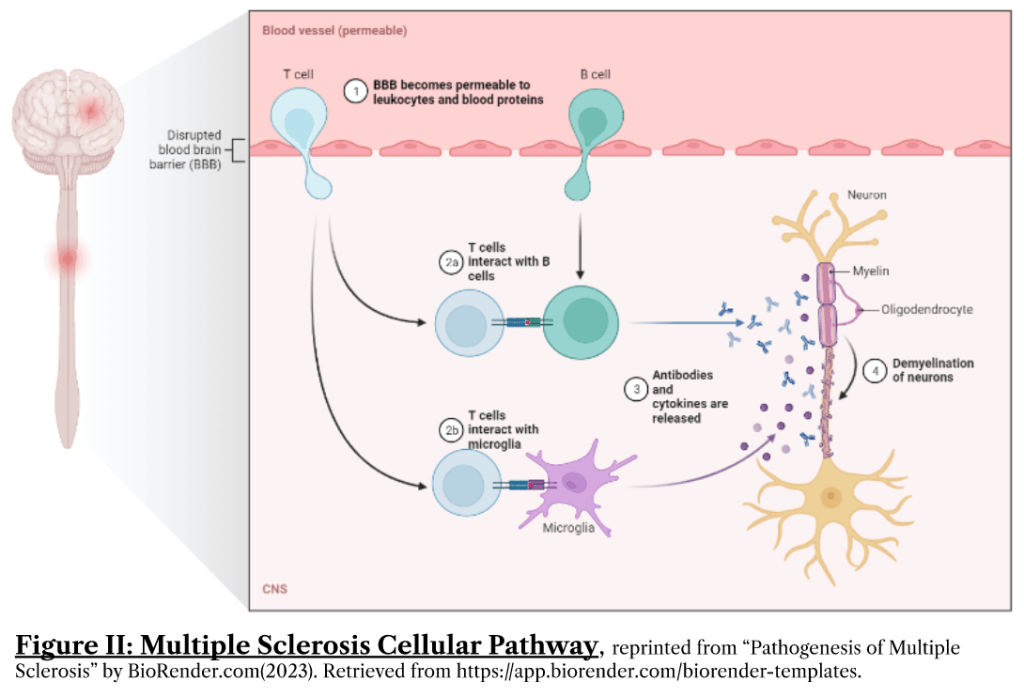
    Multiple Sclerosis (MS) is a neurodegenerative disease affecting the central nervous system, involving an autoimmune attack mediated by phagocytic microglial cells on the axons of nerves, permanently scarring the myelin sheath of numerous neurons. It is the leading cause of non-traumatic disability in young adults, with symptoms first presenting at ages 20-40. This leads to progressive neuronal dysfunction, causing neurological deficits in the autonomic and sensorimotor divisions of the nervous system and thus leading to problems with sight, muscle-coordination, balance, speech and  cognitive function (Ghasemi et al., 2017). This is summarised by Figure I. 

    The release of chemical messengers such as cytokines (e.g. Interleukin-1, Interleukin-6, TNF-α), nitrous oxide and other reactive oxidative species (ROS) results in oligodendrocyte death, and astrogliosis (hyper-proliferation of astrocytes in an effort to isolate axonal damage) that halts remyelination and results in irreversible glial scars commonly seen in MS patients (Correale and Farez, 2015). Consequently, permanent demyelination occurs as axons lose their fatty myelin sheath that provides electrical insulation from the external environment and thus means electrical signals travel much more slowly, seen in Figure II. 

    MS is known to affect females more than males, common in most autoimmune conditions (Harbo et al., 2013). Apart from this, it is also known that low vitamin D levels, trauma, smoking, obesity, early adulthood and mononucleosis (otherwise known as “glandular fever”, caused by Epstein Barr Virus) are strongly associated with development of MS (Reich et al., 2018). 

    Despite this, scientists have not been able to pinpoint specific environmental/genetic causes. This was the case until very recently, where epidemiological analysis may have just lead to another breakthrough in the field of clinical neuroscience, being the causative link between Epstein Barr Virus (EBV) infection and MS development that was established by Dr Kjetil Bjornevik and his colleagues at the department of Public Health in Harvard University.

    Before proceeding, we first need to understand what was already known about the pathophysiology of EBV infections. EBV infection is acquired before ages 5-8 in LEDCs but is delayed till adolescence/adulthood in MEDCs.  Primary infection before 5 years is mostly asymptomatic, with only those acquiring it in adolescence developing infectious mononucleosis. EBV triggers mononucleosis or glandular fever by infiltrating lymphocytes, resulting in an atypical, hyper-production of CD8+ T lymphocytes and Natural Killer (NK) cells, causing them to appear more like monocytes instead of typical lymphocytes (hence the name). 

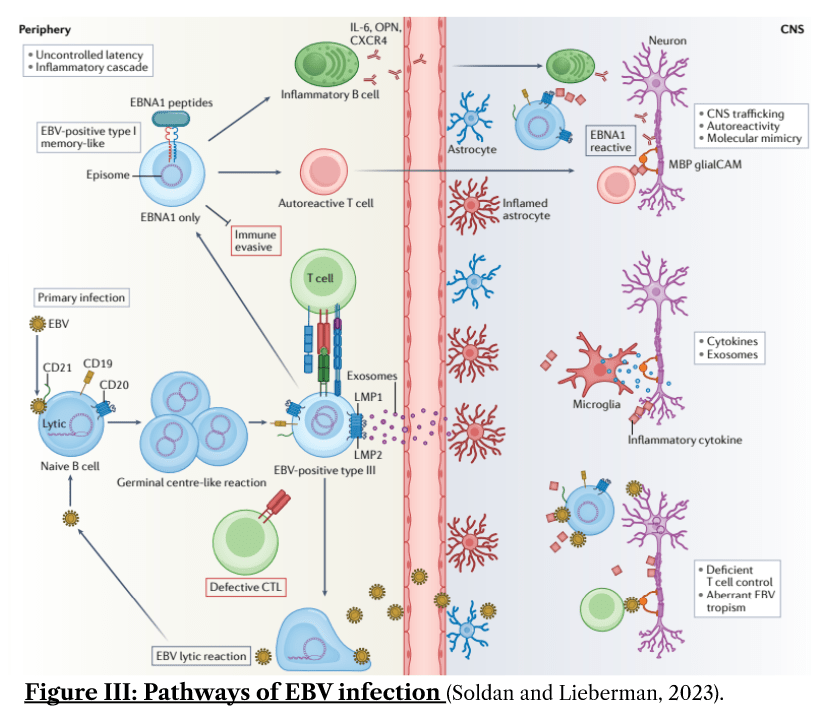
    The molecular pathway of mononucleosis is as follows: EBV particles enter squamous epithelial cells lining the airway, reproducing within them using the cell’s internal machinery and then crossing the mucosal epithelial barrier via transcytosis to infect local infiltrating B lymphocytes through gp350 and CD21 proteins found on its surface. Following this, they are shown to reprogramme germinal centres, occurring through a multitude of mechanisms, some of which include: inhibition of MHC Class II synthesis and interleukin-2 (IL-2), Interferon Gamma (IFN-γ) which are needed for CD4+ Helper T activation. It also upregulates TNF, lymphotoxin-α, PDL1 thereby disrupting both innate and adaptive immune responses oncogenically. These pathways are summarised by Figure III (Soldan and Lieberman, 2023). 

    The net effect of this is that it impairs the maturation process of B lymphocytes, allowing for numerous B lymphocytes to be produced and thus functioning as reservoirs for EBV copies, with the capability to reactivate in the oropharynx (Thompson and Kurzrock, 2004) and occasionally in the meninges of the brain (Hassani et al., 2018), leading to neurodegenerative disease. 

    Structural studies have also suggested MS development to occur via molecular mimicry, whereby components of the neuron possess structurally similar epitopes (parts of the antigen that bind to antibodies) to that produced as a response to infection, leading to autoimmune responses in the brain. Lang’s work highlighted the structural similarities that are present between EBV peptides and Myelin Basic Protein (Lang et al., 2002), an intrinsically disordered protein that constitutes approximately 30% of total CNS myelin and is a common CSF marker used in supporting neurodegenerative diagnoses including MS (Martinsen and Kursula, 2022). Crystallography revealed that the conformation of MHC parts in the TCR-α region was highly conserved, with the same TCR-peptide contacts. This is believed to exist because this helps to increase the number of epitopes that are available for antigen presentation to a single cross-reactive TCR, improving infection control by allowing for polyclonal antibodies. However, when a specific loci of the MHC class II receptor is expressed (HLA-DR2), this can lead to MS susceptibility and relapses, notably when coinciding with infections of the upper airway (Sibley et al., 1985). Thus, this can possibly lead to activation of autoreactive CD8+ Cytotoxic T lymphocytes, proven via past molecular mimicry studies on mouse models that examine CD8+ dependent autoimmune diseases affecting the heart and eyes (Chandran and Hutt-Fletcher, 2007). 

    Inspite of the above and the fact that EBV infects 90% of adults worldwide (Wong et al., 2022), only a small proportion of the infected population later develop MS as most EBV infections are not disease-causing, so understanding cofactors and aberrations in the normal infection process is vital to treatment/prevention of MS. In addition, the virus is not always found in MS lesions (Peferoen et al., 2010), so identification of MS genotypes and cofactors associated with EBV is all the more challenging. 

    However, this might have all been changed by the Harvard neuroscientists. Published in Science in January 2022, the longitudinal study featured seroepidemiological data from active, racially-diverse US military recruits across the past 2 decades with 955 recruits developing MS (Bjornevik et al., 2022). This was identified by making use of the blood samples that were routinely collected by the US Department of Defense Serum Repository (DoDSR) for HIV testing. Using these samples, they were then tested for the presence of antibodies for EBV peptides, as a marker of EBV infection and these were then matched on every characteristic (age, sex, race, ethnicity, branch of military service and collection of blood sample dates) against 2 randomly selected participants without MS, ensuring that everyone was still alive and actively carrying out military service during diagnosis to avoid confounding factors. The risk of MS was found to increase 32 fold if infected by EBV only and not viruses with similar mechanisms of infiltration such as Cytomegalovirus, with MS symptoms appearing after a median time of 7.5 years between the last seronegative sample and first seropositive sample. 

    This discovery was made by illustrating that EBV seroconversion (i.e. the process of producing specific antibodies against EBV) increased serum levels of neurofilament light chain (NFL), a neuron-specific cytoskeletal protein often used as a sensitive diagnostic marker for MS (Ning and Wang, 2022). It is a structural scaffolding protein that is needed to promote radial growth, stability and maintain the diameter of the axon during the transmission of action potentials. During axonal damage, excessive neurofilaments flood the cerebrospinal fluid and serum, with more severe levels of MS progression associated with higher serum NFL levels according to Expanded Disability Status Scales (Thebault et al., 2020).  The study found that NFL levels increased significantly 6 years prior to onset of MS and post-EBV infection, implying that it might be an accurate biomarker of the time of initiation of MS, which has always been difficult to pinpoint clinically. 

    Using VirScan for virome-wide screening, the scientists were able to identify a significantly higher anti-EBV antibody response in MS cases, with negligible changes in antibody response to the other 110,000 common viral peptides when comparing between healthy/MS patients, showing that MS development was not merely due to opportunistic viral infections.

    In addition, 97% seroconversion was observed in people that developed MS, showing that a substantial amount of people that acquired MS later were EBV positive earlier and this relation seems to be unique. This is because MS risk was surprisingly lower with Cytomegalovirus (CMV) positive than CMV negative patients, which suggests that the immune response to CMV ameliorates the adverse effects of EBV.  

    All these staggering statistics illustrate that EBV infection precedes MS development, providing strong evidence that it is a likely cause of MS whilst also highlighting techniques that could be standardised for the diagnosis of MS such as serum NFL testing. It also suggests that directly targeting EBV through EBV-specific T-cell therapy may thus be more fruitful than anti-CD20 monoclonal antibodies that are usually prescribed as effective treatment for MS, as it averts the risks of intravenous admission and risks of greater/more severe opportunistic infections with depleted memory B cells as drawbacks of anti-CD20 therapies.

    Thus, this highlights the need for rigorous epidemiological and biochemical studies as presented here. By understanding the principal factors of the inflammation leading to irreversible MS, we are better able to identify key therapeutic targets for MS patients and enhance their quality of life through more successful treatment plans.

    References

    Bjornevik, K., Cortese, M., Healy, B.C., Kuhle, J., Mina, M.J., Leng, Y., Elledge, S.J., Niebuhr, D.W., Scher, A.I., Munger, K.L. and Ascherio, A. 2022. Longitudinal analysis reveals high prevalence of Epstein-Barr virus associated with multiple sclerosis. Science. 375(6578), pp.296–301.

    Chandran, B. and Hutt-Fletcher, L. 2007. Gammaherpesviruses entry and early events during infection In: A. Arvin, G. Campadelli-Fiume, E. Mocarski, P. S. Moore, B. Roizman, R. Whitley and K. Yamanishi, eds. Human Herpesviruses: Biology, Therapy, and Immunoprophylaxis [Online]. Cambridge: Cambridge University Press. [Accessed 1 April 2023]. Available from: http://www.ncbi.nlm.nih.gov/books/NBK47405/.

    Correale, J. and Farez, M.F. 2015. The Role of Astrocytes in Multiple Sclerosis Progression. Frontiers in Neurology. 6, p.180.

    Ghasemi, N., Razavi, S. and Nikzad, E. 2017. Multiple Sclerosis: Pathogenesis, Symptoms, Diagnoses and Cell-Based Therapy. Cell Journal (Yakhteh). 19(1), pp.1–10.

    Harbo, H.F., Gold, R. and Tintoré, M. 2013. Sex and gender issues in multiple sclerosis. Therapeutic Advances in Neurological Disorders. 6(4), pp.237–248.

    Hassani, A., Corboy, J.R., Al-Salam, S. and Khan, G. 2018. Epstein-Barr virus is present in the brain of most cases of multiple sclerosis and may engage more than just B cells. PloS One. 13(2), p.e0192109.

    Lang, H.L.E., Jacobsen, H., Ikemizu, S., Andersson, C., Harlos, K., Madsen, L., Hjorth, P., Sondergaard, L., Svejgaard, A., Wucherpfennig, K., Stuart, D.I., Bell, J.I., Jones, E.Y. and Fugger, L. 2002. A functional and structural basis for TCR cross-reactivity in multiple sclerosis. Nature Immunology. 3(10), pp.940–943.

    Luo, C., Jian, C., Liao, Y., Huang, Q., Wu, Yuejuan, Liu, X., Zou, D. and Wu, Yuan 2017. The role of microglia in multiple sclerosis. Neuropsychiatric Disease and Treatment. 13, pp.1661–1667.

    Martinsen, V. and Kursula, P. 2022. Multiple sclerosis and myelin basic protein: insights into protein disorder and disease. Amino Acids. 54(1), pp.99–109.

    Ning, L. and Wang, B. 2022. Neurofilament light chain in blood as a diagnostic and predictive biomarker for multiple sclerosis: A systematic review and meta-analysis. PLOS ONE. 17(9), p.e0274565.

    Peferoen, L.A.N., Lamers, F., Lodder, L.N.R., Gerritsen, W.H., Huitinga, I., Melief, J., Giovannoni, G., Meier, U., Hintzen, R.Q., Verjans, G.M.G.M., Van Nierop, G.P., Vos, W., Peferoen-Baert, R.M.B., Middeldorp, J.M., Van Der Valk, P. and Amor, S. 2010. Epstein Barr virus is not a characteristic feature in the central nervous system in established multiple sclerosis. Brain. 133(5), pp.e137–e137.

    Purves, D., Augustine, G.J., Fitzpatrick, D., Katz, L.C., LaMantia, A.-S., McNamara, J.O. and Williams, S.M. 2001. Neuroglial Cells. Neuroscience. 2nd edition.

    Reich, D.S., Lucchinetti, C.F. and Calabresi, P.A. 2018. Multiple Sclerosis. The New England journal of medicine. 378(2), pp.169–180.

    Sibley, W., Bamford, C. and Clark, K. 1985. CLINICAL VIRAL INFECTIONS AND MULTIPLE SCLEROSIS. The Lancet. 325(8441), pp.1313–1315.

    Soldan, S.S. and Lieberman, P.M. 2023. Epstein–Barr virus and multiple sclerosis. Nature Reviews Microbiology. 21(1), pp.51–64.

    Thebault, S., Abdoli, M., Fereshtehnejad, S.-M., Tessier, D., Tabard-Cossa, V. and Freedman, M.S. 2020. Serum neurofilament light chain predicts long term clinical outcomes in multiple sclerosis. Scientific Reports. 10(1), p.10381.

    Thompson, M.P. and Kurzrock, R. 2004. Epstein-Barr virus and cancer. Clinical Cancer Research: An Official Journal of the American Association for Cancer Research. 10(3), pp.803–821.

    Verkhratsky, A., Ho, M.S., Zorec, R. and Parpura, V. 2019. The Concept of Neuroglia. Advances in experimental medicine and biology. 1175, pp.1–13.Wong, Y., Meehan, M.T., Burrows, S.R., Doolan, D.L. and Miles, J.J. 2022. Estimating the global burden of Epstein–Barr virus-related cancers. Journal of Cancer Research and Clinical Oncology. 148(1), pp.31–46.

  • What Does The Renin-Angiotensin-Aldosterone System (RAAS) Have To Do With Long COVID?

    What Does The Renin-Angiotensin-Aldosterone System (RAAS) Have To Do With Long COVID?

    Zak Muggleton, Year 3

    Patients with ‘long’ COVID-19 end up with a variation of symptoms, involving a large array of systems. This includes respiratory system (cough, breathlessness), cardiovascular system (chest pain, palpitations), MSK system (joint and muscle pain), ENT symptoms (permanent loss of smell/taste, tinnitus, earache), gastrointestinal system (abdominal pain, nausea), neurological system (brain fog, delirium, visual disturbance) and psychological symptoms (anxiety, PTSD, depression). This is not an extensive list (NHSInform, 2023). 

    Approximately 15% of all adults who caught COVID reported experiencing long COVID symptoms for some period of time, with the most being women aged 45-54 reporting long covid symptoms (Walker et al, 2021). According to some recent studies, an antibody attacking the mediator of the renin-angiotensin-aldosterone system (RAAS) may be the culprit for these symptoms. 

    The RAAS system is initiated, as low blood pressure is detected by the kidneys, so renin is released. Renin converts angiotensinogen into angiotensin I. Then angiotensin I travels to the lungs or the kidneys, where angiotensin converting enzyme (ACE), converts angiotensin I into angiotensin II. Angiotensin II then stimulates the adrenal cortex to release aldosterone, as well as the pituitary gland being stimulated to release antidiuretic hormone (ADH). This, in combination, leads to increased salt retention that raises blood pressure. It also leads to vasoconstriction (blood vessels becoming smaller to increase blood pressure), hypertension and cardiac hypertrophy (increase in cardiac muscle due to strain of pumping blood around the body). 

    In opposition, in a non-affected individual, angiotensin-converting enzyme 2 (ACE2) converts angiotensin I (AT1) into angiotensin 1-9 (AT1-9) (further converted into angiotensin 1-7 (AT1-7) by ACE) and ACE2 converts angiotensin II (AT2) into AT1-7. This AT1-7 leads to vasodilation (expansion of the vessels to decrease blood pressure) and hypotension. This system allows the RAAS system to not overwork the body, and lead to systemic effects. 

    In COVID, an antibody begins to attack ACE2. ACE2 is an enzyme that can be found either on the membrane of cells (membraneACE2 (mACE2)) or soluble in the body (solubleACE2 (sACE2)). These mACE2 cells are the main passageway of entry for COVID molecules into the cell, and they can be found on the intestines, kidneys, testis, gallbladder or in the heart. As these COVID molecules attach to these ACE2 molecules, the body can no longer vasodilate as effectively, and the RAAS system is allowed to work on overdrive. Therefore the immune system is not activated, and vasodilation does not occur, so damaged tissues do not get adequate blood flow, and there is a less effective delivery of oxygen and nutrients. (DAIC, 2021). Further precipitating the problem is the kallikrein-kinin system which regulates sodium channels using bradykinin, lowering blood pressure and producing reactive oxygen species. COVID has been shown to increase bradykinin levels, leading to further vasoconstriction (Beyerstedt S, 2021). 

    Although there are no studies confirming this link, does this lack of vasoconstriction lead to the development of long COVID? What is certain is that the suppression of ACE2 leads to harmful hypertension in these COVID patients. There is also evidence that oestrogen regulates the expression of ACE2 in the body, so potentially patients who have decreased oestrogen, for reasons such as menopause,  become exponentially more at risk of long COVID due to the lack of ACE2 (American Physiological Society, 2020). This could explain why middle-aged women are seemingly most likely to be affected by long COVID.  

    References

  • Novel Neuroanatomy Shields The Brain and Regulates Cerebrospinal Fluid

    Novel Neuroanatomy Shields The Brain and Regulates Cerebrospinal Fluid

    The neuroscientists’ latest discovery may provide the SLYM chance needed to reverse the progression of Alzheimer’s, Parkinson’s, Multiple Sclerosis and more…

    Rishabh Suvarna, Year 1

    The brain, with its 80 million neurons, is one of the most fascinating, vital and elusive organs that distinguishes the human species from the rest of the other organisms on the planet. A century ago, intricate cognitive functions like emotion, thought and behaviour were shrouded in mystery, but with more precise instruments and rigorous study designs, significant networks of the brain have been identified, leading to a more comprehensive understanding of the central nervous system (Lisman, 2015). Despite recent advancements in the clinical neurosciences and neuro-imaging techniques, appallingly little is known about how the brain functions down to the microscopic level (Batista-García-Ramó and Fernández-Verdecia, 2018). 

    On Thursday, 5th January, a recent breakthrough discovery published in Science has unveiled a previously undiscovered layer of neuroanatomy that shields grey matter, regulates cerebrospinal fluid and recruits immune cells to monitor for infection. This poignant finding stems from the brilliant minds at the University of Copenhagen, namely Maiken Nedergaard, co-director for the Center of Translational Neuromedicine and Dr. Kjeld Mollgard, M.D. Their combined genius revolutionised the field of neuroscience as we know it, with their discovery of the glymphatic system as the brain’s waste removal method (Hablitz and Nedergaard, 2021; Plog and Nedergaard, 2018) and the elucidation of the function of glial cells (Holst et al., 2019). In fact, Mollgard first suggested that an mesothelial barrier that lines other vital organs and systems must also exist within the CNS – a fact that was only recently proven through their study.

    This study focuses on the passage of cerebrospinal fluid and the membranes surrounding the brain, traditionally thought to be the meningeal connective tissue layer. This was thought to comprise of an external tough outer layer called the dura mater (latin for “hard mother of the brain”), followed by an internal thin, well vascularised and tightly attached layer called the pia mater and the arachnoid mater, a web-like structure within the cerebrospinal fluid  that connects to the pia mater. The cerebrospinal fluid is a transparent, colourless fluid that maintains homeostasis within the CNS, containing an aqueous solution of neurotransmitters, proteins and glucose (Wichmann et al., 2022). It cushions the CNS and was thought to be produced by the choroid plexus and absorbed in the subarachnoid spaces, however exact details were yet to be explained.

    Mollgard and Nedergaard’s study illustrates however that a 4th layer exists below the arachnoid mater in the subarachnoid space, called the Subarachnoid Lymphatic-like Membrane (SLYM), serving as a bifurcation of this space. SLYM was named as such because it was found directly in the subarachnoid space, being lymphatic-like because it drains excess CSF just as lymphatic vessels normally would.

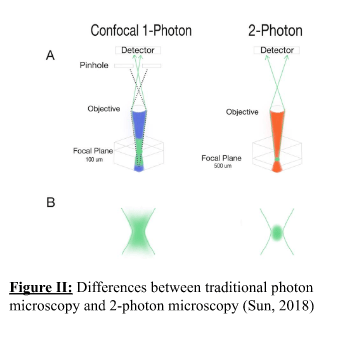
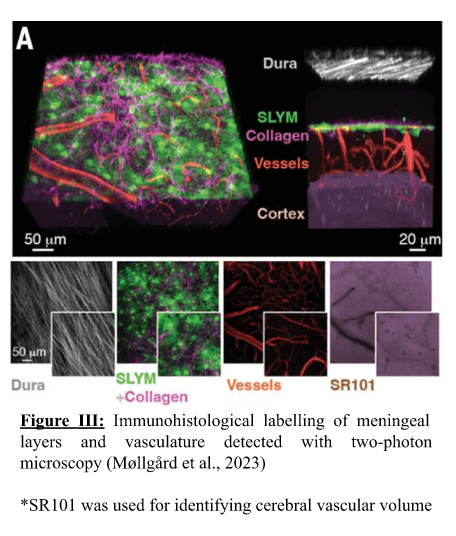
    This discovery was achieved through two-photon electron microscopy, an expensive but powerful fluorescent imaging technique that utilises very fast 80 MHz laser pulses to fire two photons on biological tissue within 1 femtosecond (Lévêque-Fort and Georges, 2005). This technique provides high specificity for visualising tissue at a greater depth whilst maintaining high contrast, resolution and reducing issues of scattering, phototoxicity and photobleaching (Helmchen and Denk, 2005; Benninger and Piston, 2013), seen in Figure II. 

    In the study, Prox1, a transcription factor relevant in lymphatic system formation, was fluorescently labelled in the dura mater and astrocytes, and two-photon electron microscopy was then applied. This helped them discover a loosely packed layer of collagen bundles and Prox1 cells that sub-divided the arachnoid space into an outer superficial section and an inner deep section that became the SLYM layer. Further testing with this technique demonstrated that it acts as an ultrafilter, separating clean and dirty CSF fluid by filtering against fine solutes (> 3kDa molecular weight) such as cytokines, growth factors and other peptides such as amyloid beta and tau, implicated in Alzheimer’s Disease. Fluorescence labelling showed that it possessed many lymphatic markers, some of which were not expressed in the pia/dura mater, and expressed PDPN, a common marker found in mesothelial cells and hence its classification as a mesothelial, lymphatic-like layer. This labelling also showed it lined the entire brain from front to back whilst possessing significantly different vasculature to the other meningeal layers that is populated by leukocytes. All of the above clearly indicates that it is a distinct mesothelial layer from the pia, dura and arachnoid maters, seen in Figure III.  

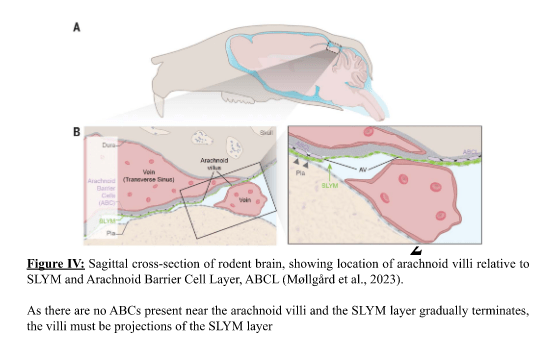
    In addition to this, it was found to form arachnoid villi lining the subarachnoid space and acting as a one-way valve that prevents the backflow of CSF. As a result, it is implied that the SLYM’s function is not only to filter CSF solutes and direct the flow of CSF into arterioles in the outer subarachnoid space, but also in CNS immune response. 

    While this study was conducted primarily on mice brains, it was also demonstrated to exist within human brains. What made this study a significant finding was not only the fact that human brains possessed a mesothelial layer as immunological defence for the CNS, but also that it may have a substantial role in diseases such as Alzheimer’s, Parkinson’s, Dementia and Schizophrenia – all of which have been related to disorders in the passage of CSF via the glymphatic system (Zhang et al., 2022).  The filtration system of the SLYM layer for CSF solutes accentuates the need for better low molecular weight treatment if given through spinal fluid intrathecally, as this can impair the effectiveness of such biologics(Soderquist and Mahoney, 2010). Interestingly, when this layer was damaged and CSF leakage occurred, two-photon electron microscopy detected these solutes on both sides of SLYM, which may perhaps explain the process of ageing and the progression of neurodegenerative diseases. Furthermore, treating the mice brains with LPS to stimulate bacterial infection as well as sampling older brains revealed a considerable surge in the variety and number of immune cells present, potentially explaining the correlation between ageing and reduced/impaired CSF distribution, in turn leading to neurodegenerative diseases (Zhang et al., 2022). SLYM layer damage may allow for hypersensitivity reactions to take place, as immune cells from the SLYM layer may attack the inner subarachnoid space and thereby the brain directly, consequently leading to prolonged neuroinflammation post traumatic brain injury and greater risk of neurodegenerative diseases. Given that some neurological diseases are postulated to be auto-immune in nature such as multiple sclerosis (Wootla et al., 2012; Barkhane et al., 2022), the SLYM layer may promote the progression of such diseases as lymphatic-like tissue can easily become hypersensitive when inflamed by viral infections, molecular mimicry etc. In fact, this discovery may even explain why sleep produces many neuroprotective effects for the brain, given that the glymphatic system is primarily active during restful REM sleep and in mostly inactive during wakefulness (Jessen et al., 2015), and that poor sleep has been correlated with impaired CSF circulation and hence amyloid-beta plaque accumulation (Sprecher et al., 2017).

    Even though more research is required in understanding the specific mechanisms in which SLYM can get damaged and how this leads to neurodegenerative disease, this provides a solid ground for gaining a better understanding and appreciation for the role of cerebrospinal fluid and the glymphatic system in maintaining our brain.

    References:

    Barkhane, Z., Elmadi, J., Satish Kumar, L., Pugalenthi, L.S., Ahmad, M. and Reddy, S. 2022. Multiple Sclerosis and Autoimmunity: A Veiled Relationship. Cureus. 14(4), p.e24294.

    Batista-García-Ramó, K. and Fernández-Verdecia, C.I. 2018. What We Know About the Brain Structure–Function Relationship. Behavioral Sciences. 8(4), p.39.

    Benninger, R.K.P. and Piston, D.W. 2013. Two-Photon Excitation Microscopy for the Study of Living Cells and Tissues. Current protocols in cell biology / editorial board, Juan S. Bonifacino … [et al.]. 0 4, Unit-4.1124.

    Hablitz, L.M. and Nedergaard, M. 2021. The Glymphatic System: A Novel Component of Fundamental Neurobiology. The Journal of Neuroscience. 41(37), pp.7698–7711.

    Helmchen, F. and Denk, W. 2005. Deep tissue two-photon microscopy. Nature Methods. 2(12), pp.932–940.

    Holst, C.B., Brøchner, C.B., Vitting‐Seerup, K. and Møllgård, K. 2019. Astrogliogenesis in human fetal brain: complex spatiotemporal immunoreactivity patterns of GFAP, S100, AQP4 and YKL‐40. Journal of Anatomy. 235(3), pp.590–615.

    Jessen, N.A., Munk, A.S.F., Lundgaard, I. and Nedergaard, M. 2015. The Glymphatic System – A Beginner’s Guide. Neurochemical research. 40(12), pp.2583–2599.

    Lévêque-Fort, S. and Georges, P. 2005. MICROSCOPY | Nonlinear Microscopy In: Encyclopedia of Modern Optics [Online]. Elsevier, pp.92–103. [Accessed 29 January 2023]. Available from: https://linkinghub.elsevier.com/retrieve/pii/B0123693950008290.

    Lisman, J. 2015. The challenge of understanding the brain: where we stand in 2015. Neuron. 86(4), pp.864–882.

    Michaud, M. 2023. Newly Discovered Anatomy Shields and Monitors Brain. URMC Newsroom. [Online]. [Accessed 29 January 2023]. Available from: https://www.urmc.rochester.edu/news/story/newly-discovered-anatomy-shields-and-monitors-brain.

    Møllgård, K., Beinlich, F.R.M., Kusk, P., Miyakoshi, L.M., Delle, C., Plá, V., Hauglund, N.L., Esmail, T., Rasmussen, M.K., Gomolka, R.S., Mori, Y. and Nedergaard, M. 2023. A mesothelium divides the subarachnoid space into functional compartments. Science. 379(6627), pp.84–88.

    Plog, B.A. and Nedergaard, M. 2018. The glymphatic system in CNS health and disease: past, present and future. Annual review of pathology. 13, pp.379–394.

    Soderquist, R.G. and Mahoney, M.J. 2010. Central nervous system delivery of large molecules: challenges and new frontiers for intrathecally administered therapeutics. Expert opinion on drug delivery. 7(3), pp.285–293.

    Sprecher, K.E., Koscik, R.L., Carlsson, C.M., Zetterberg, H., Blennow, K., Okonkwo, O.C., Sager, M.A., Asthana, S., Johnson, S.C., Benca, R.M. and Bendlin, B.B. 2017. Poor sleep is associated with CSF biomarkers of amyloid pathology in cognitively normal adults. Neurology. 89(5), pp.445–453.

    Sun, V. 2018. Dissecting Two-Photon Microscopy. Signal to Noise. [Online]. [Accessed 29 January 2023]. Available from: http://www.signaltonoisemag.com/allarticles/2018/9/17/dissecting-two-photon-microscopy.

    Wichmann, T.O., Damkier, H.H. and Pedersen, M. 2022. A Brief Overview of the Cerebrospinal Fluid System and Its Implications for Brain and Spinal Cord Diseases. Frontiers in Human Neuroscience. 15, p.737217.

    Wootla, B., Eriguchi, M. and Rodriguez, M. 2012. Is Multiple Sclerosis an Autoimmune Disease? Autoimmune Diseases. 2012, p.969657.

    Zhang, D., Li, X. and Li, B. 2022. Glymphatic System Dysfunction in Central Nervous System Diseases and Mood Disorders. Frontiers in Aging Neuroscience. 14.

  • Running Towards Academic Success

    Running Towards Academic Success

    Katie Webb, Year 3

    Sport and PE make up an important part of school curriculums. But how beneficial are these subjects in the pursuit of academic success?

    Many children give up playing sports as they approach important school exams – but is this beneficial? In short, no. A study in 2019 suggested that playing sport is positively associated with mental toughness and psychological wellbeing and that there is a small association between playing sport and academic achievement (Moxon et al, 2019). Other studies have also shown a considerable association between schools producing successful sporting teams with higher academic achievement and graduation rates, and crucially found that in schools with similar demographics and funding, those with larger sports programmes fared better academically (Bowen and Greene, 2012). Interestingly, one study found that even if an hour per day was taken from other subjects to increase the time spent on physical activity in primary schools, academic results improved, and equally if PE time was reduced, there was no benefit to academic achievement (Montecalbo-Ignacio, Ignacio and Buot 2017). It is therefore reasonable to accept that there is an association to sports participation and achievement and academic achievement. But the interesting question is why.

    There is much evidence that exercise improves cognitive performance and memory, and therefore it is not unreasonable to suggest that general academic performance might also be improved by these factors (Di Liegro et al, 2019). The biochemical interactions underpinning it are not fully understood but the resulting increase in grey matter in the frontal and hippocampal regions (Colcombe et al, 2006) (Erikson et al 2011), as well as the upregulation of the release of neurotrophic factor (Coelho et al, 2013), is well recognised. Therefore, one argument to explain the link between academic performance and sport is simply a neuroscientific one.

    It could also be argued that sport develops characteristics that enable academic success. Regular aerobic exercise is associated with greater resilience to stress), improved self-esteem and higher levels of general wellbeing (Nowacka-Chmielewska et al, 2022) (Eime et al 2013) (Steptoe and Butler, 1996). It is very plausible that these are mediating factors that result in improved academic performance. That is, that the psychosocial skills gained from sport and exercise overlap with those required for academic success.

    There is also an argument that the link is simply correlation rather than causation. Simply consider a confounding factor such as socioeconomic status, which is associated both with exercise level (Federico et al, 2013) and academic performance (Brooks-Gunn and Duncan, 1997). In other words, that someone a higher socioeconomic status is likely to increase academic performance and sport participation independently. It is not hard to imagine a situation where a child is born into a well-off family and has numerous opportunities to compete in sport as well as resources and tutoring to succeed academically. However, as discussed earlier (Bowen and Greene, 2012), even those studies that control for factors such as school demographic and funding, there appears to be an association between sports and academic achievement. 

    Like most things in life, the reason for this link is likely to be multifactorial. The chances are, if you take up running you won’t instantly turn into Einstein, but it is also unlikely to have a negative effect on your academic success. Be it as the result of biochemical reactions or the development of psychological and social skills, or some other reason, this surely must play into educational planning. Set against the context of huge academic uncertainty, and likely entering yet more years of government austerity, it is likely that schools, universities and workplaces will be cutting budgets wherever they can. In times like these, it’s typically subjects like maths, English and science that get focussed on at the expense of subjects like PE and music. Let’s hope they listen to the science and know that cutting time spent on sport is unlikely to yield any better academic results. 

    References:

    Bowen, D.H., & Greene, J.P. (2012). Does Athletic Success Come at the Expense of Academic Success. Journal of Research in Education, 22, 2-23.

    Brooks-Gunn, J., & Duncan, G. J. (1997). The effects of poverty on children. The Future of children7(2), 55–71.

    Bruno Federico, Lavinia Falese, Diego Marandola & Giovanni Capelli (2013) Socioeconomic differences in sport and physical activity among Italian adults, Journal of Sports Sciences, 31:4, 451-458, DOI: 10.1080/02640414.2012.736630

    Coelho, F. G., Gobbi, S., Andreatto, C. A., Corazza, D. I., Pedroso, R. V., & Santos-Galduróz, R. F. (2013). Physical exercise modulates peripheral levels of brain-derived neurotrophic factor (BDNF): a systematic review of experimental studies in the elderly. Archives of gerontology and geriatrics56(1), 10–15. https://doi.org/10.1016/j.archger.2012.06.003

    Colcombe, S. J., Erickson, K. I., Scalf, P. E., Kim, J. S., Prakash, R., McAuley, E., Elavsky, S., Marquez, D. X., Hu, L., & Kramer, A. F. (2006). Aerobic exercise training increases brain volume in aging humans. The journals of gerontology. Series A, Biological sciences and medical sciences61(11), 1166–1170. https://doi.org/10.1093/gerona/61.11.1166

    Di Liegro, C. M., Schiera, G., Proia, P., & Di Liegro, I. (2019). Physical Activity and Brain Health. Genes10(9), 720. https://doi.org/10.3390/genes10090720

    Eime, R. M., Young, J. A., Harvey, J. T., Charity, M. J., & Payne, W. R. (2013). A systematic review of the psychological and social benefits of participation in sport for children and adolescents: informing development of a conceptual model of health through sport. The international journal of behavioral nutrition and physical activity10, 98. https://doi.org/10.1186/1479-5868-10-98

    Erickson, K. I., Voss, M. W., Prakash, R. S., Basak, C., Szabo, A., Chaddock, L., Kim, J. S., Heo, S., Alves, H., White, S. M., Wojcicki, T. R., Mailey, E., Vieira, V. J., Martin, S. A., Pence, B. D., Woods, J. A., McAuley, E., & Kramer, A. F. (2011). Exercise training increases size of hippocampus and improves memory. Proceedings of the National Academy of Sciences of the United States of America108(7), 3017–3022. https://doi.org/10.1073/pnas.1015950108

    Montecalbo-Ignacio, R.C., Ignacio, R.A., & Buot, M.M. (2017). Academic Achievement as Influenced by Sports Participation in Selected Universities in the Philippines. Education 3-13, 7, 53-57.

    Moxon, P., Clough, P., Dagnall, N., Clough, E., & Elstone, D. (2019). The potential benefits and costs of participation in school sport. Physical Education Matters, (Autumn 2019), 26-28.

    Nowacka-Chmielewska M, Grabowska K, Grabowski M, Meybohm P, Burek M, Małecki A. Running from Stress: Neurobiological Mechanisms of Exercise-Induced Stress Resilience. Int J Mol Sci. 2022 Nov 1;23(21):13348. doi: 10.3390/ijms232113348. PMID: 36362131; PMCID: PMC9654650.
    Steptoe, A., & Butler, N. (1996). Sports participation and emotional wellbeing in adolescents. Lancet (London, England)347(9018), 1789–1792. https://doi.org/10.1016/s0140-6736(96)91616-5