Elizabeth Ratcliffe, Year 3
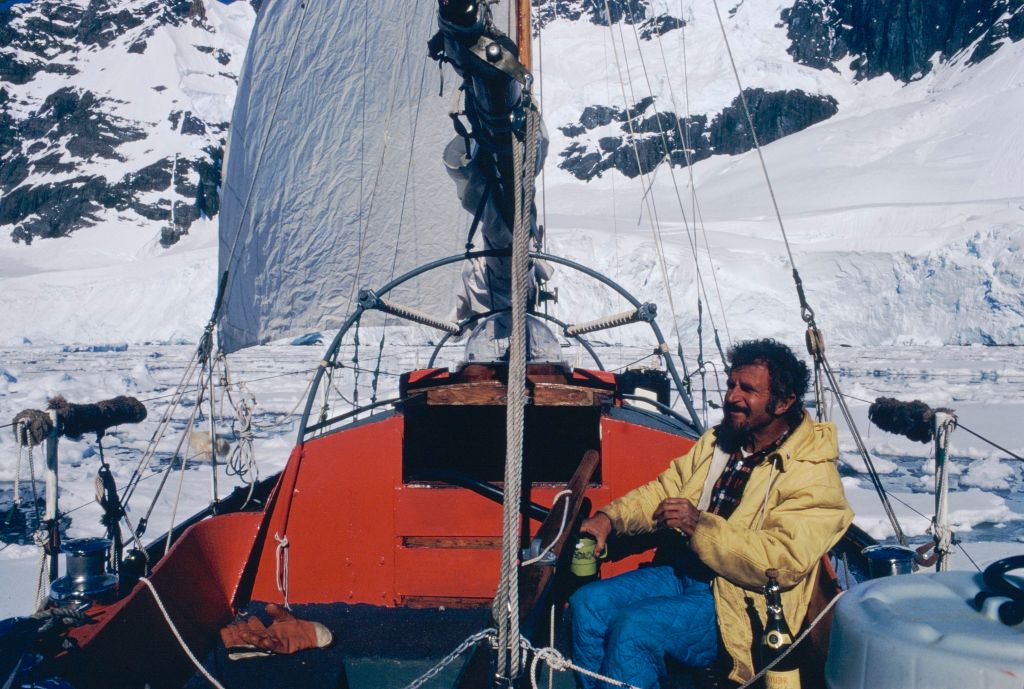
Leeds graduate, David Henry Lewis, is best remembered as the Kiwi adventurer who sailed the world, and yet his 2002 obituary hints at his other life as a doctor who was integral in the establishment of the NHS. Lewis was born in England but raised in New Zealand and Rarotonga; he was educated in a Polynesian school and firmly identified as a New Zealander. Described as “short, sturdy and tough” Lewis was well-suited to skiing and mountaineering but committed to a medical career instead and he arrived in Leeds in 1938 to complete his education. He also served as a medical officer in a paratroop regiment during World War Two.
Lewis’ sailing career started in 1960, when the breakdown of his first marriage (he was an unashamed lifelong womaniser) reignited the ‘adventurer bug’ in him and he competed in the first solo trans-Atlantic race and came third. He briefly returned to medicine in the UK, however for Lewis, an unusual doctor with a sometimes-bizarre bedside manner (he was known to examine patients only in his swimming trunks) it was unsurprising that his NHS career was short-lived. In 1964 he took his second wife and two young daughters and completed the first circumnavigation of the globe in a multihull ‘Rehu Moana’. He then sought to learn traditional Polynesian navigation techniques from Micronesian sailors – responding to their questions of why in his mild but tenacious manner: “My name is David Lewis, I come from the village of London in the island of England, and I have come to sit at the feet of your wise men and learn how to find my way across the sea”. But even that adventure wasn’t enough, Lewis went on to capsize alone in the Antarctic, establish the Oceanic Research Foundation, extinguish an onboard fire and survive a crew mutiny.
Alongside Lewis’ sailing celebrity, in his brief career as a doctor he played an important part in the foundation of the NHS. Although the National Health Service Act of 1946 pledged to provide a family doctor for the entire population, Aneurin Bevin had failed to persuade GPs that universal healthcare was important enough to sacrifice their independent (and often very lucrative) private practices. Therefore, the foundation and 1948 introduction of the NHS was reliant on support from a few key GPs whose action forced those resistant to comply. Approximately ninety percent of patients had signed up to those doctors willing to enter the scheme within the first month, leaving behind a crumbling system of private healthcare. David Henry Lewis was one of the few doctors willing to risk the security of their careers on the NHS. Lewis’ support was unsurprising given his political beliefs: he was a communist who vehemently opposed political systems with bureaucracy that failed the poor (Putt, 2002). Although Lewis’ legacy is not one of individual medical innovation or genius, the NHS was the result of a social revolution and brave systemic change that introduced the first universal healthcare system in the world. And the gamble Lewis took paid off, the 1948 mortality index showed a twenty percent decline compared to 1938 (which had the lowest standardised mortality of any year pre-WW2) and a drastic improvement in public health was seen; the NHS altered medical practice immeasurably and imbedded itself in the sociocultural psyche of the UK.
Described by fellow adventurer Dick Smith as a “wonderfully fantastic scallywag” Lewis recorded his adventures in 12 successful books and shared his love for the ocean and traditional navigation with thousands. He sailed well into his eighties, even after losing his eyesight, and after he died in 2002 his ashes were scattered in his beloved Pacific ocean. Although Lewis is well remembered as a sailor, adventurer and anthropologist, his contribution to the pioneering work of the infant NHS should not be forgotten as its impact is immeasurable.
Sailing well into his eighties, even after losing his eyesight, Lewis is only well remembered as a sailor, adventurer, and anthropologist despite his contribution to the pioneering work of an infant NHS being possibly just as, if not more, impactful.
References:
Putt, C. 2002. The sailor who set out to see it all. [Online]. [Accessed 13 January 2023]. Available from: https://www.smh.com.au/national/the-sailor-who-set-out-to-see-it-all-20021116-gdftrz.html
Rivett, G. 2019. 1948-1957: Establishing the National Health Service. [Online]. [Accessed 13 January 2023]. Available from: https://www.nuffieldtrust.org.uk/chapter/1948-1957-establishing-the-national-health-service
Thompson, M. 2017. The NHS and the public: a historical perspective. [Online]. [Accessed 13 January 2023]. Available from: https://www.kingsfund.org.uk/blog/2017/10/nhs-and-public-historical-perspective
Ministry of Health. 1950. Public Health in 1948: Remarkable Statistics: the first months of the Nation Health Service. [Online]. Ministry of Health. [Accessed 13 January 2023]. Available from: https://cdm21047.contentdm.oclc.org/digital/collection/tav/id/1116
 THE WORSLEY TIMES
Leave a comment