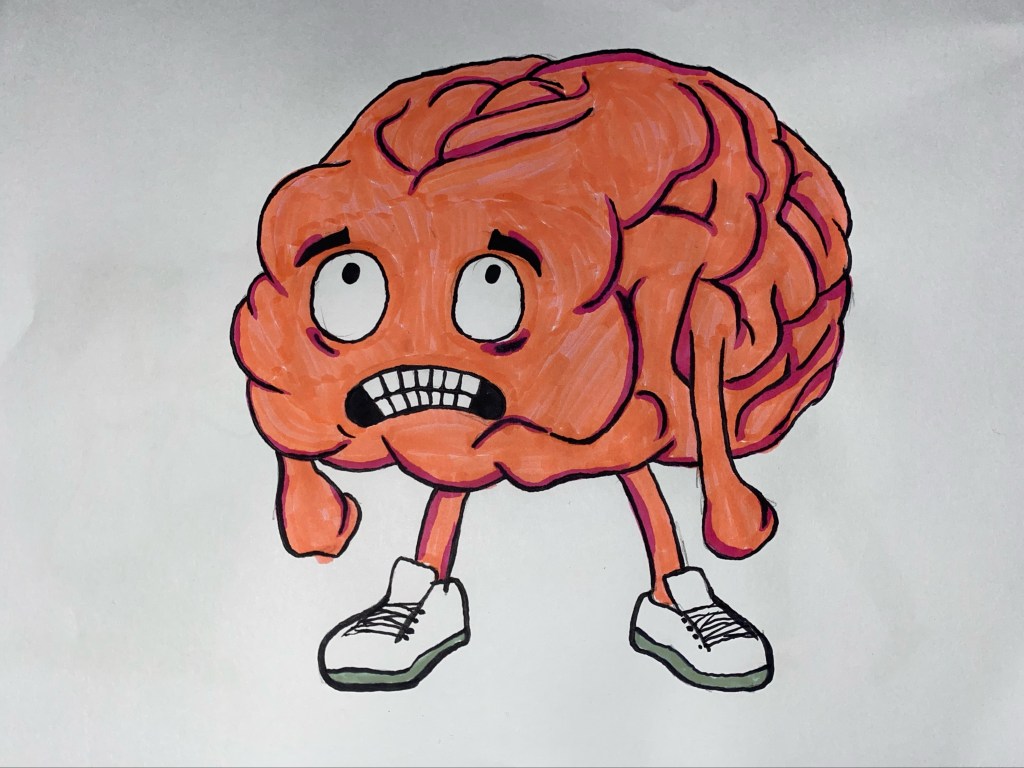
Holly Dobbing, Year 3
Anxiety. We’ve all felt it. Or I’m sure we all have, unless you’re a cold-hearted, no-feeling, psychopathic Patrick Bateman. In that case, good for you. I envy you. Anxiety is such an awful feeling: your heart is pounding, your skin is tingling, you’re sweaty and jittery and you just can’t get your breath. It’s all-consuming. It’s not like a broken arm where the pain is confined to one limb because it’s everywhere – your heart, your lungs. Even your brain feels scrambled. It feels overwhelming and inescapable, but it’s just a feeling, right? It’s all in our heads… right?
In some ways—yes—anxiety is all in your head. But not in the way you think. Anxiety actually changes the biochemistry of your brain (Stoneridge, 2021). When you feel anxious, your body is in ‘fight or flight’ mode – your body is preparing to cope with whatever is making you anxious – so your central nervous system is flooded with adrenaline and cortisol (NIMH, 2022). In a scary situation, these hormones are really helpful. Adrenaline boosts your heart rate, blood pressure and energy supplies (2021), and cortisol is responsible for increasing the supply of glucose to the brain (2021). This ensures the body can deal with the scary situation and subsequently return to its resting, calm state. However, in anxiety, this ‘calm’ state seems infeasible. It’s impossible to grasp, like trying to grab onto a cloud. This means the stress hormones continue to precipitate a cycle of stress hormone release until the brain is swimming in cortisol and adrenaline and you just feel completely overwhelmed (Stoneridge, 2021).
Anxiety can also change the proportions of the structures in your brain – your amygdala may grow larger if you regularly experience anxiety (Stoneridge, 2021). The amygdala is the part of the brain that copes with emotion and mood (Swanson and Petrovich, 1998). It sends signals to the hypothalamus when it senses a threat which triggers our fight or flight response and starts the stress hormone cycle I mentioned earlier (Swanson and Petrovich, 1998). When you’re anxious, your amygdala is larger and hypersensitive, making it easier to trigger the high stress state we associate with anxiety (Stoneridge, 2021) – this means people with anxiety may ‘overreact’ to situations or become triggered when others don’t.
The connections between the amygdala and prefrontal cortex are also weaker in those with anxiety so when the amygdala reacts to a threat, the logical, rational prefrontal cortex doesn’t respond the way it does in non-anxious brains (Stoneridge, 2021). Normally the prefrontal cortex rationalises threats, but when we’re anxious and the connection is weaker, we lose our problem-solving brain and become more erratic (Stoneridge, 2021).
Anxiety can also cause your hippocampus to shrink (2021). This makes it more difficult to store and remember memories – especially happy ones (Stoneridge, 2021). In other words, anxiety is making it harder to hold on to your happy memories, so you’re more likely to remember failures, sad moments, and danger. Yet again, anxiety precipitating more anxiety.
So yes. Anxiety is all in your head. But that doesn’t make it ‘made up’ or invalid in any way whatsoever. Mental health conditions are health conditions and need to be treated with just as much respect and sincerity as any other health condition. Anxiety is and will always be hard to manage, especially on top of university and our busy student lives. This said I hope understanding more about how anxiety physically affects your brain helps to keep things in proportion when you do inevitably experience those scary feelings. They are scary but they are also real and valid and legitimate, and you are not alone!
Useful links if you suffer with anxiety:
- https://www.mind.org.uk/information-support/types-of-mental-health-problems/anxiety-and-panic-attacks/self-care/
- https://students.leeds.ac.uk/info/100001/counselling_and_wellbeing/957/counselling_wellbeing_and_mental_health_support
- https://www.healthline.com/health/mental-health/how-to-cope-with-anxiety
- https://adaa.org/tips
References:
2021. Chronic stress puts your health at risk [Online]. Mayo Clinic. Available: https://www.mayoclinic.org/healthy-lifestyle/stress-management/in-depth/stress/art-20046037#:~:text=Adrenaline%20increases%20your%20heart%20rate,of%20substances%20that%20repair%20tissues. [Accessed 25th October 2022].
NIMH. 2022. Anxiety Disorders [Online]. Available: https://www.nimh.nih.gov/health/topics/anxiety-disorders [Accessed 25th October 2022].
STONERIDGE. 2021. How Does Anxiety Affect the Brain [Online]. Available: https://stoneridgecenters.com/how-does-anxiety-affect-the-brain/#:~:text=When%20you%27re%20anxious%2C%20your,brain%20to%20hold%20onto%20memories. [Accessed 25th October 2022].SWANSON, L. W. & PETROVICH, G. D. 1998. What is the amygdala? Trends in Neurosciences, 21, 323-331.
 THE WORSLEY TIMES
Leave a comment