By Austin Keane. Year 3.
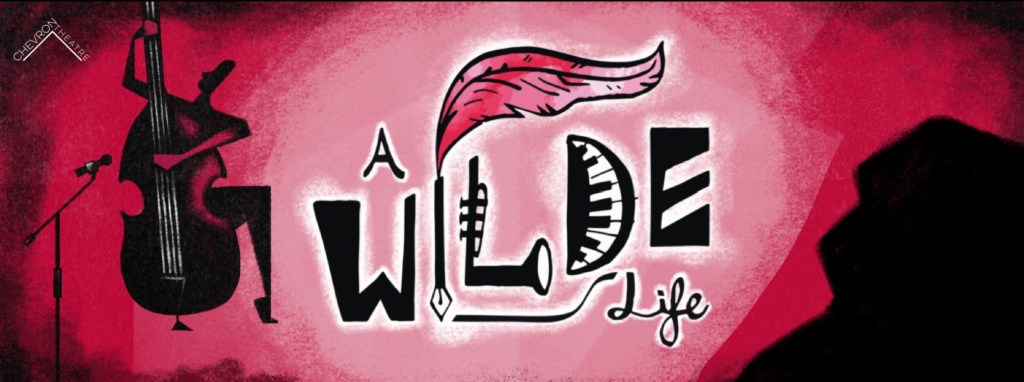
Illustrated image by Milly Fern Parker.
Rating: ★★★★★
“C’est moi!”—two indelible syllables and Oscar Wilde appears before us, reminding us not so much who he is as what he is—iconoclast, critic, decadent—as what he does: Oscar Wilde (Jack Glantz) has something to say.
A Chevron Theatre production, “A Wilde Life” has imminent dates in Cambridge (Town and Gown) before running at the Edinburgh Fringe from the 15th-27th of August. Created by Andie Curno, George Marlin, Alex Boulton and Mia Ruby, this is a musical chronicling Wilde’s life—a Herculean task, but one that this team has executed brilliantly; glittering with barbed charm, this production is as bold as the man himself.
The scene opens in a sleazy Parisian café, thick with the honeyed misery of a dying age: sex-workers flirt with each other and the audience; bartenders and regulars gossip with distinct ease. Rather sensibly, no French accents are attempted. The space hums with potentiality—a piano and two tables, a handful of glasses, everything smothered with red cloth—sparse enough to allow the actors to establish much of the physical context. It is effectively done so that there is a certain volatility to the scenes, as if they might come apart at any moment. Accordingly, the movements of each actor becomes crucial. Thankfully, they prove themselves more than equal to it.
With a swaggering grandeur Glantz made his entrance to the stage, slow and posturing, possessed with all the calm of someone who knows how to capture a room. Immediately we were grounded with ‘Oscar in Paris,’ a thrumming jazz number that remained for me the most memorable. Alex Boulton as the pianist for the café is a permanent fixture, lending real warmth in his attenuated focus as he lets the rest of the ensemble perform. Boulton, with Julian Schwarz, managed to effortlessly capture the zeitgeist. The entire score is a mixture of blues and jazz to express Wilde’s fractured history, swollen with rich melodies and eddying rhythms.
The characters onstage required some further attention before they revealed themselves to us. Wilde as we know him does not exist in a vacuum. Rather, he is a cultural emblem, predicated on the idea of an audience (“A Wilde Life” grasps this well). In the very same way, we conjure Wilde through this act of assembly: the ensemble is transformed one-by-one into members from his past. The metaphysics of the display are as funny as they are perceptive. Wilde once demanded an audience that would receive him—tonight it is only right that he commands one to tell his story. This conveys something else as well, that we are in good hands with people who understand this history, and why exactly they owe a duty to rewrite it.
Ajay Sahota as Robbie Ross is the first figure summoned from Wilde’s past, and his first paramour that we are introduced to. Sahota plays the ingénu with stunning ease, constantly fumbling for meaning without verging on the ridiculous. A scene in which he drinks whisky for the first time had the whole room nervously laughing, such was the real physical tension between Sahota and Glantz; in the charged stillness there was a latent sense of danger. Wilde appears to tease Ross with his lack of restraint (“I see much of myself in you.”) and in doing so teases us, the audience, with the subtext, revelling in the error of our logic—that what is hidden must continue to be.
The next characters to appear are Ada Leverson (Imogen Chancellor) and Lady Jane (Dalia Kay), a fellow writer-friend and Wilde’s mother respectively. Chancellor is just as clear in her acerbic control of language as Kay is dominating when employing her own. Here, the creators emulate well that archetypal Wildean mode of speech, its searing musicality; bracingly unsentimental, everything is set hard and bright in its paradox. Chancellor‘s ability to match perfectly Wilde’s desire to shock is a thrilling thing to discover in real time as she, the bar patron, assumes her role as Ada.
The next two songs (’Love and Art’ and ‘Careful Darling’) capture Wilde in his reflections between Glantz, Chancellor and Kay—we cannot have him whole. Indeed, not even his wife—as we are often reminded—could. I especially appreciated the time given to the women in his life. Being able to see them in context and talking to one another is invaluable when it comes to understanding our protagonist. Too often they are made bloodless and dull in the face of Wilde’s character; here they exist just as brashly, are just as vividly with arguably comparable limitations, entirely to the show’s credit.
Not long after, the most moving scene from the show occurs between Wilde and Bosie (Zak Muggleton-Gellas) who embodies the spoiled youth impeccably, his features suffused with an almost caffeinated sheen. They sit and read to one another silently throughout “Eternal Youths,” the faltering melody drawn out between them in the starkness of their intimacy that needs no other framing, no other distraction but themselves. For Bosie, innocence is an instant away from entitlement, a transformation made even more likely with each giddy breath. Because of this dichotomy, as the show progresses Muggleton-Gellas’s performance changes radically, a contrast that is both comical and at times distracting. Further, there is that incessant poisoned lyric: Narcissus, Hyacinth. For some, these are images attended by tragic stories of metamorphosis—a man paralysed in his reflection, another struck dead by a god, both taken then into new flower; for others these are just the flowers themselves. Death by Beauty, or rather death to Beauty, in surrendering to the beauty of other men, or to just their image—this is what Wilde warns us of; this is what the audience knows to fear. This is what Wilde’s wife Constance (Freya MacTavish) knows she has to compete with.
MacTavish, finding herself caught between institutions and the will of a man determined to both defy and entertain them, makes easy work of the spurned lover. A curdling exhaustion marks her performance of “Silly Connie,” for me, the most impressive of the entire show. The control she assumed over the space was unimpeachable with an equally undeniable vocal performance. It is at this point that our villain made an appearance: the Marquess of Queensberry (Millie Fern Parker) is coming to take Oscar down with “Make Him Pay.” These songs together explore different responses to Wilde’s actions and the effect he had on them in return. Opposing the two characters emphasises the phenomenal diversity in opinion surrounding Wilde among his contemporaries. Parker provides the majority of the comedy for the show with her coiled wit lashing at Wilde and anyone else who dares oppose her (Dirty fruits!) culminating in his famous trial and ultimate sentencing.
Though the trial itself is heavily truncated—the effect of an arrow sprung perfectly to hit its mark barely a foot from its release—it is no less convincing for the exacting puncture mark it leaves. That Glantz can conjure a real sense of loss in “De Profundis” without the context of a long battle is a testament to his performance and the definite choreography of the scene. It is in this song that Glantz best assumes Wilde’s character, with strong vocals thronged with bitterness as he writes to Bosie from prison. Everything has the impression of careful consideration. Even in its ending.
One of the most impressive aspects of the show was the attention paid to its characters’ costumes by Daisy Fox and Emma Wilcox. These are subtle marks of genuine passion and a clear demonstration of the intelligence of the team in their effort to conjure genuine people with fine qualities of taste and appearance: a darting red is woven into hair at the crown; a dress hemmed with fine red thread stirs in response. Everyone wears that same red and black. To change a single costume is unimaginable—the incredible details mark them as seamless in each individual case.
The production itself, headed by Ben Nuttall with Kate Matthews, is of the most immense quality. Perfectly balanced, like the fine movements of a clock’s machinery, you hardly notice the achievement for its subtlety. The lighting delineates the scenes perfectly without muddying them, always remaining clipped. It is only when you remember that there must be a construction, that the production is itself organised, can you hear that steady ticking and perceive each immaculate movement. The well-coordinated dancing of the cast (joined necessarily by Caitlin Etheridge and Casiah Palmer Sterling as Cyrille and Vyvyan, Wilde’s children) was a surprising aspect of the show for me. Dynamic and playful, the choreography accentuated the show with a level of professional ability that was a genuine pleasure to witness. Etheridge and Sterling deserve further recognition for joining the harmony of babbling voices for the duration of the show while never seeming to take up unnecessary space on the stage, holding their own even when underutilised.
By this I mean Wilde’s children remain largely unexplored beyond their naming, and that considering their relationship to youth, beauty and legacy, there’s much fun that could be had here both musically and otherwise. In addition to this, slowing down the first couple of scenes would help to clarify some of the dialogue that remained indistinct. Glatz too would benefit from this in “A Wilde Life” that was, though visually engaging, more difficult to follow. Each of these seem to be the most obvious effects of a shorter running time however, and something easily resolved.
The other thing I noticed is that, at times, Wilde’s prose falls a little too quickly from the mouths of other characters. The final act of summoning Oscar to himself is done using this very device, powerful in its utter sense and conviction—what other man would trust to save himself? Elsewhere however, it can at times feel like an act of smug puppetry on behalf of the writers. Similarly, “Sodomite” being misspelt by the Marquess—a pivotal narrative moment—was not clearly explained, requiring the audience to already be acquainted with Wilde’s story. Finer details like this may help to broaden the audience in engaging with the narrative.
Ultimately, the great effect of Wilde’s characterisation is that the creators emphasise the importance of expression within queer identity—that there must remain a necessary distinction between liberation and assimilation. In capturing Wilde’s commitment to excess the writers are showing the audience the value of audacity, in demanding what you are owed. Art for art’s sake is radical because it is a commitment to the self, beyond utility or influence. We must commit to the beauty of an image—our own image—without its interrogation. With magnificent dexterity, much of Wilde’s philosophy bleeds through the show: here Aestheticism, the commitment to beauty alone, fits snugly alongside domestic drama, and some truly excellent musical numbers. This is a phenomenal achievement that the entire team should be incredibly proud of. Lydia Duval’s work with marketing is also a distinct feat, capturing the wit of the show and helping to broaden its access via social media. The gorgeous illustrations for the posters further emphasise the professional nature of the production. Created by Parker, the broad-edged black and red lines help to establish the dark, rich tone. The cast and crew of “A Wilde Life” have captured the tragicomedy of the world’s first modern celebrity with all of the vigour and vim it might ever be possible to summon, culminating in the single best show I have seen all year.
***
My final thoughts linger on that first act of construction, of being called to act out this history. And the miracle of it, leaving each audience member wondering at that same possibility, whether they might be called to live out a story—of beauty or anguish, of tragedy and humour?
After all, “It is the spectator, and not life, that art really mirrors.”
“C’est moi!”—no Oscar: c’est nous! It’s us!
Either way, you’re in for a Wilde ride…
[Tickets available on FIXR: Search for ‘A Wilde Life’]
 THE WORSLEY TIMES
Leave a comment