Austin Keane, Year 2
All images by Joe Fenna.
“In the beginning…”—and so we begin, met with the incipit from Genesis 1:1 that informs creation. A bold start, I must admit, but one that this production delivers on.
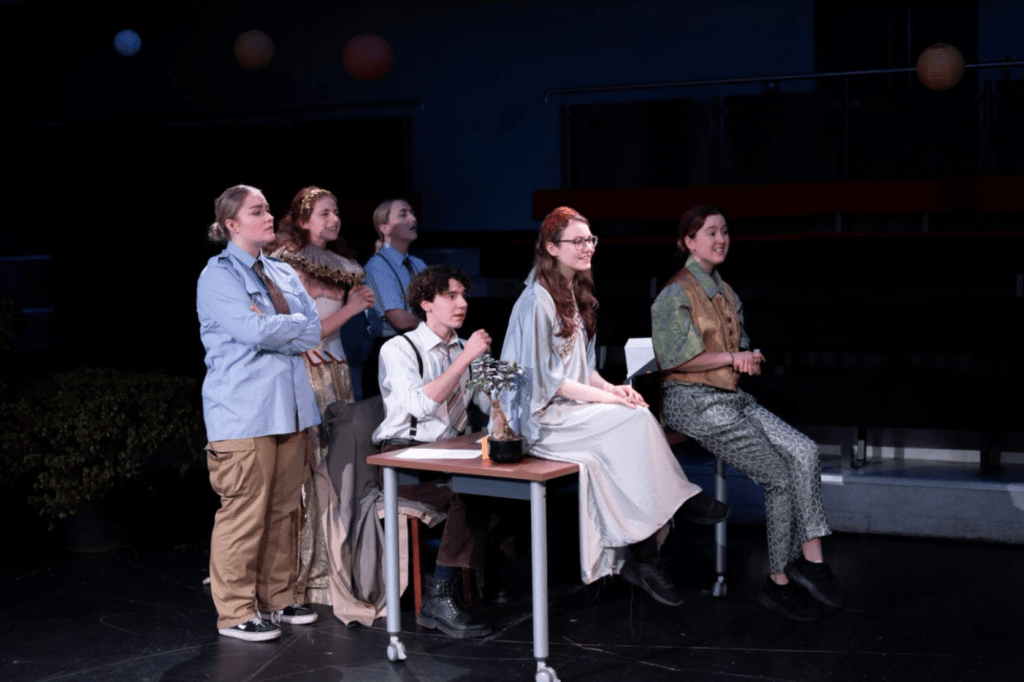
Written by Harry Daisley—the Worsley Times’ very own, if we may dare to point out—and assistant directed by Alicia Edwards and Sam Adlam, “The Velvet Veins” (Open Theatre) ran from the 17th -19th of March in the Pyramid theatre. Producers Ellery Turgoose, Sam Cooke and Ellie Gelber ensured the space was utterly transformed: pastel-coloured lanterns swelled the air above the stage, falling and rising as you passed your eye across the room; a desk and a throne were only vaguely conspicuous aside a cell; two drapes hung from back wall, spiderwebbed with black illustrations, designed by Rosie Margree. Lines bisected and overlapped—torsos, snails, almost-human things, were deformed and spun in ink, to later significance. Here nothing has true borders; nothing is clear, except, perhaps, for one thing: in the beginning, it seems, there was fashion.


The play straddled comedy and drama with impressive consistency, examining the relationship between two siblings: the Empress (Marta Vittoria Fiorini) and the Chancellor (Beth Crossley), and the way their lives accommodate for the kidnapping of (the fabulous) Lord Leonard Ludwig Bazaar (Erin Cooke) from the power of one to the other. We soon establish the rules: vegans and drag and gays are exports from the Empress’ domain, and that there exists a cultural distance between the two kingdoms, mapped snugly to the geographical and emotional estrangement of the siblings. Further, there are some laws of nature (that is to say culture) that cannot be broken: avocadoes, as ever, remain universal.
The play’s focus on dualities—and their contradictions—was most clearly demonstrated in the nuanced performances of Fiorini and Crossley as our two sovereigns: they navigate each other’s stories and contexts deftly, carefully sidestepping the suggestion that they are victims of a certain creation and preferring to opt for rivalry instead. Crossley’s performance especially showed remarkable development as the play progressed, sweetly contrasting the increasing fever of Ludwig’s will to escape with subtle venom and unsubtle rage. Meanwhile, Cooke’s Ludwig managed to act as the Chancellor’s twisted mirror, a constant contradiction to further both their characterisation whilst retaining a whole image herself. They carried the weight of the emotional context for the first act in this way, simmering perfectly together; they challenged each other in inches with the hope of unravelling miles.
The Duchess’ performance was something else entirely—dropping my pen halfway through the first act, my hand itched to pick it up. I looked down to find it shook for a moment, and made the sensible decision to wait until the Empress had stopped talking. Fiorini was brilliantly expressive, entertaining a shrill control of language and a caustic, fluid motion to make even the slightest interaction deliciously entertaining. These courtroom scenes were further ornamented with the help of two aides, Alicia Edwards as Quintus and Isla Delfy as Helene. Each vying to be more tolerably-unconvincingly demure in a competition for the Empresses’ affection, they bicker and chide with an almost Wildean musicality. If, especially with the opening sequences, the plot meanders a little, sometimes too pleased with the hectic loveliness of its minor characters—it is convincing enough to be enjoyed, even at the expense of the wider narrative.
Later on we met the painfully earnest Mr Alexander (Barney Milton), refreshingly unaffected, and commendably so, in the face of his company, the brilliant Kurt and Burt (played by Maisy Dodd and Ruby Sparks respectively). Their dynamic presence on screen was a perfect antidote to the increasing misery being summoned by both siblings. Selene, played by Iris Webster, we glimpse little of and then much, providing us a nice sense of expansiveness within this ecosystem—we come to know her as first a spectator, much as we are, then a tired lover, then an agent within the actual operation on stage. She is possessed by her own desires and impulses, and we watch her compel the others to do the same, challenging their ideas of conduct, and of taste—much to the Empress’ disapproval.
Designed by Rose Margee, the detail pertaining to each costume was immense. With everything from a ruff to flares, still nothing was amiss. Opulence and hedonism could be spied in each swath of the Empress’ fabric, and the close attention paid to everyone else’s outfits, though less singularly dramatic, was no less effective. It cultivated a very material reality to our characters as well as emphasising the role of presentation and the power of appearance within the wider play. We critique them for the same reasons that the kingdoms they speak of critique them. Selene’s honesty about her clothes—predominantly woollen—and her literal hand in their creation challenge the authenticity of both our leaders, even the Empress who is well served by her appearance and wider performance.

With each narrative revolution the actors change places, much as a bead of water twists and cleaves itself down the knife; lights flicker off and we are transported again to a place of unreality, where our opening sequence unfolded. This is the real jewel at the heart of the show. An in-between space where monologues can unravel without the fetter of reality. It happens only a few times but consistently to powerful effect, conjuring stillness without awkwardness. I felt my blood for a moment, roiling inside me—the lights dimmed as if to wick the noise that swelled the room. My veins flickered, hummed. The hanging art lingers, always behind them, starched, still.
The central conceit of the play is delightful, silly within the realms of this world. Dramatic irony is employed exquisitely to full effect, as we laugh at them figuring it out. It’s thrilling and feverish and well done. The script holds for the most part in this same fashion (badum-chhh), wavering only slighting with regards to pacing in the second act and some of the dynamics—obscured and not—between a few of the characters.
For example, I wanted to hear more of Timon (Samantha Cass), who in the final act was possessed with a vulnerability and fierceness that we have come to suspect Timon is troubled by. Cass’s sensitivity is an unutilised force elsewhere, visible only at the periphery of their scenes. The other was the romance between Mr Alexander and Selene. It comes a little too easily, or obviously, his passivity welded to her directness; a moment or two of stuttering contact and they perceive the other with the sly understanding of new feeling. Selena’s “I belong to nobody” sounding a little pained by virtue of how quickly we might be expected to forget it. Of course, love is not possession. I mean more that it felt a little incongruous: they are drawn together like magnets, with little emotional interest, even if it is sweet enough, and funny, to watch. (They are both—undeniably— very skilled at making us laugh.)


This incongruity was made even more obvious by their centring in place of Ludwig and the Chancellor, whose dynamic was arguably both more complex and interesting. On this point special notice should be given to Callie O’Brien, the sound designer. The majesty of a royal court was conjured effortlessly with a springing up of strings, and later on the atmosphere was transformed again with the song “Yes Sir, I Can Boogie.” It’s this that the Chancellor and Ludwig danced with each other to. Their bodies seemed softer under a new shifting light, turgid with warmth—the illustrations behind them coming alive, guttering in and out of focus, some vivid, some wild, all for the first time possessed with inertia. Some classic homoerotic tension hovered in the air, unwritten but unimpeachable, much to the barely-stifled pleasure of the giggling audience. (Significantly, I include myself among them on this matter.) For their subtext to be made vernacular, however, their silent conflict rewarded, would have been more hard-won and more satisfying. I know this is too simple: mutual isolation is no basis for a relationship; nor is kidnapping!. But to name the broken thing would clarify to us its power, and not muddy why exactly it is that they can’t be together—not a certain love but a certain pride; for a man obsessed with dress, a certain mask of pretending. Then the love may dare to speak its name, after all.
In the closing scenes there are several stunning moments of actualisation: the Chancellor wears his art as his own, revealed earlier to be those same drapes, a sardonic elegance employed as violence so now the Empress can see the truth of her cruelty. We watch as Timon leaves, abandoning the pursuit of love as transformation, and Mr Alexander claims his forename (though it will remain unrecorded here) being recreated under his new love. But best of all is the ultimate monologue—where Ludwig leaves, abandoning both siblings. He violates the rubric that had been established, releasing himself from his choice of two in search of another, of the Other; to a place “where clocks strike thirteen,” to a place where he may know even better what it is that he has now just for the first time understood—the force of his will, his existence in all its potentiality—and leaping, there—within his “velvet veins.” It expressed perfectly the tensions that had been amassing throughout the play, and the necessary release from them, whatever the cost.
*
Our clothes afford us agency in expression; we can reinvent, accommodate certain aesthetic exports to substantiate ourselves, our feelings even. We wear them in the hope that they imbue us with something greater than ourselves. Or to be even more dangerous: that we might approximate our true measure in them and demonstrate this, without affectation. It is, it seems, a creation story after all, compelling us—as both Timon and Ludwig do in the end—to think about what it is that we might do; to eat the apple or not; whether we might leave a garden dictated to us—choose to—and forge a place where our creation is our own.
An excellent team of actors and crew brought to life a genuinely compelling and thoughtful script. If what the Chancellor extols to us is true, and “art never sleeps” then, with this production as evidence, the cast and crew of The Velvet Veins may be—for a while yet—content in their insomnia.
 THE WORSLEY TIMES
Leave a comment