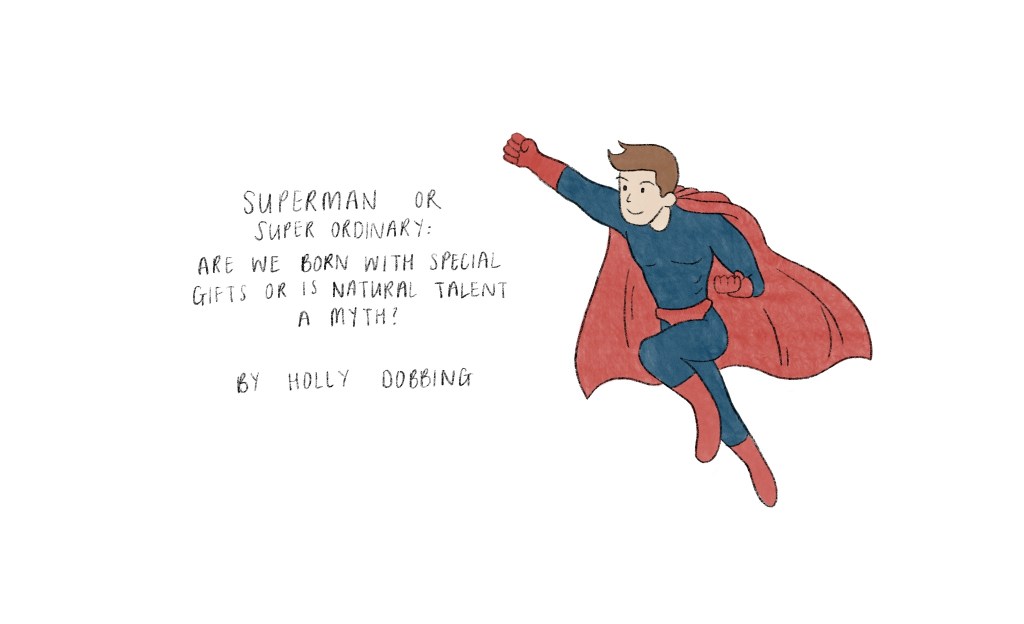
Holly Dobbing, Year 2
I’m sure you know someone who makes solving maths equations look as easy as reciting the alphabet. Or there’s always that one addition to your quiz team who seems to have an eidetic memory. And even people with gifts for sports, who can turn their hand at any physical activity and appear like they were born to do so. We can all think of people who seem so naturally talented in a given area, that it seems impossible that they weren’t born with some sort of genetic advantage. But is this the case? Are some of us born with different abilities or are there other factors at play?
Of course, practice is pivotal to excelling in a certain field. Violinists in the world’s top orchestras don’t achieve that level of excellence without complete dedication and gruelling practice throughout their lives. Likewise Olympic athletes and world-class sportspeople, elite academics and even those people who can solve a Rubik’s cube in under a minute aren’t able to do these things overnight. In his book ‘Talent is Overrated’, award-winning journalist Geoff Colvin discusses the importance and necessity of ‘deliberate practice’ in being successful (Colvin, 2019). He explains how we often assume we have either have an aptitude for something, or we don’t, when actually no one fits into these strict categories—talent isn’t something you have or not, it is something you gain (Colvin, 2019). He also says ‘great performance isn’t reserved for a preordained few’ because in reality, there is nothing genetic or insurmountable difference separating us from world-class performers except practice.
Another key and often over-looked factor is opportunity. This can be as simple as where you live. In his book ‘Bounce’, international table-tennis champion Matthew Syed discusses the true nature of talent and how success isn’t confined to those with a genetic predisposition to greatness (Syed, 2010). He talks about his success in table tennis, and how the street he grew up on produced ‘more outstanding table-tennis players than the rest of the nation combined’ (Syed, 2010). Was someone putting something in the water? No. They just all happened to attend the same school, with the same hard-working coach, and a high performing table-tennis club nearby (Syed, 2010). He also talks about a similar scenario in Canada, where almost all top ice-hockey players are born in January, February or March (Syed, 2010). Of course, this isn’t due to some crazy genetic mutation—it’s actually because the boys born earlier in the year were more likely to be picked by scouts because they looked bigger, stronger and more mature, and so would have additional opportunities to train and practice and therefore improve quicker and ultimately be more successful (Syed, 2010). Strange to think, but if you imagine one of your role models—maybe if they were born somewhere else or at a different point in time, they wouldn’t be where they are today. Maybe if Tiger Woods was born six months earlier, he wouldn’t even know how to hold a golf club. Similarly, maybe if you were born in the catchment area of a different school, you would be at the next Olympics representing team GB in the diving final alongside Tom Daley. Maybe not. But just maybe.
Still, even after reading all of this, I wasn’t one hundred percent convinced. What about people who excel at something the very first time they try it? You may argue that typically these people have prior experience in similar activities, where the very basic principles are the same. For example, being good at tennis because you have previously played badminton, or even less tangible links like being good at art and becoming an excellent surgeon (some studies indicate artistic hobbies improve dexterity and subsequently improve surgical practice (ADEA, 2022)). I’m still not convinced, but I think partly this is because it feels almost like a betrayal to be told that natural talent is a myth. We’re so used to looking up to our role models and thinking there is something special about them that sets them apart from us. But actually, maybe there isn’t. Perhaps it really does come down to opportunity and practice.
It’s interesting because we’re so quick to believe that our circumstances in life reflect the disadvantages and failures we experience—not getting into your chosen university or not making it onto the top sports team—but we seem to be so reluctant to believe that these things could also give us advantages. Yes, it’s obvious that you will have advantages if you’re born into a family with lots of money and influence, but you can also be privileged just by being born at the beginning of the school year, or by being the youngest child in the family. Ultimately, what I’m trying to say is this: talent may or may not be a concept made by humans to explain people who are more successful than ourselves, but it is not confined to a select few. Hard-work and determination will result in success.
References
ADEA. 2022. The Importance of Manual Dexterity [Online]. Available: https://www.adea.org/GoDental/Application_Prep/Preparing_for_Dental_School/The_Importance_of_Manual_Dexterity.aspx [Accessed 16th March 2022].
COLVIN, G. 2019. Talent is Overrate: What Really Separates World-Class Performers from Everybody Else, Nicholas Brealey Publishing.
SYED, M. 2010. Bounce: The Myth of Talent and the Power of Practice, UK, Fourth Estate GB.
 THE WORSLEY TIMES
Leave a comment