Amy Wilson, Year 2
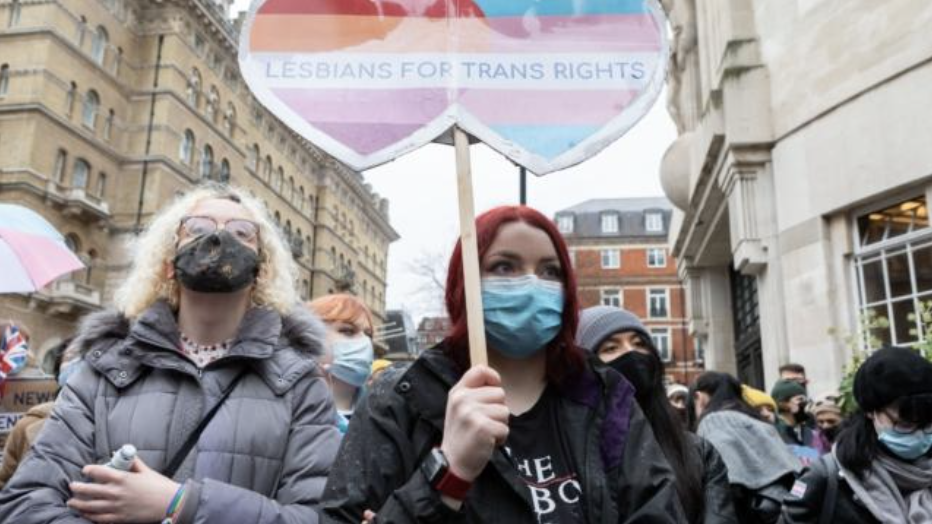
Stone, G. (2022) – Image of the protests following the ban’s announcement
The Government’s decision not to ban conversion therapy for transgender people just days after this year’s Trans Day of Visibility has shown why, now more than ever, we need to be educated on issues that will affect our trans friends, family, colleagues and patients.
Conversion therapy, also known as cure therapy or reparative therapy, refers to any form of treatment or psychotherapy that aims to change or suppress an individual’s sexual orientation or gender identity (Stonewall 2022). The Trevor Project, a charity that focuses on LGBTQ+ mental health and suicide prevention, states that conversion therapists use “a variety of shaming, emotionally traumatic or physically painful stimuli to make their victims associate those stimuli with their LGBTQ identities” (Young, S. and Ng, K. 2022). It can take place in a variety of contexts, such through religious, cultural or healthcare groups (Ban Conversion Therapy 2022).
It is not an uncommon occurrence. Alarmingly, 7% of LGBT people have been offered or undergone conversion therapy, jumping to 10% of asexual people and 13% of trans people (Ban Conversion Therapy 2022). In healthcare settings, 1 in 20 LGBT people have been pressured to question or change their identities when accessing services (Stonewall 2022).
As a practice, it has been widely condemned. In the UK, all major counselling groups alongside the NHS have signed a Memorandum of Understanding decrying it (Stonewall 2022). This is due to its numerous negative impacts, such as increased depression, suicidality, self-hatred and social isolation (GOV.UK 2022). As practitioners of evidence-based medicine, the lack of credible support for it is key as we consider the Government’s failure to ban conversion therapy for trans people.
Initially, the government said it would drop plans for the ban for all LGBTQ+ people, announcing that ministers would explore non-legislative routes (Milton, J. 2022). It then announced that the ban would go ahead for LGB people, but not their trans counterparts. This led to enormous backlash, with LGBTQ+ organisations and The Memorandum of Understanding Coalition Against Conversion Therapy (MOU), whose members include NHS England, the BMA and several major counselling and psychotherapy bodies, openly criticizing the motion (Parry, J. and Moss, L. 2022). Both the Welsh and Scottish governments have been investigating routes for banning transgender conversion therapy (Milton, J. 2022).
The ban will impact the trans community in multiple ways, but particularly within medicine. The BMA Media Office (2022) pointed out that “services for trans individuals in the NHS are already insufficient; the waiting list for young people to access gender identity development services can be two years or more”. They later went on to say that without the protection of the conversion therapy ban, trans and nonbinary people will likely face increased amounts of isolation and social prejudice.
This is on top of current prejudices within medicine. According to Stonewall and YouGov (2018), two-thirds of trans people in their study had avoided treatment out of fear of prejudice, likely due to 20% of them having witness discriminatory or negative remarks regarding LGBTQ+ people.
Trans people are not just being discriminated against in the UK. With Florida’s “Don’t Say Gay” Bill, LGBTQ+ people could be forcibly outed and discriminated against within schools in the state (Woodward, A. 2022). Additionally, trans people in Ukraine are being prevented from crossing borders due to the gender markers on their passport being perceived as incorrect, leading to fears of being trapped in a country with no anti-discrimination laws and in danger of Russia’s transphobic policies (Tondo, L. 2022).
Trans and nonbinary people are being discriminated against in the UK and beyond. As medical students with a responsibility to our patients, I urge all cisgender students to take the steps to educate themselves and include this community in your work. It may only seem like small steps but doing whatever we can matters now more than ever.
Further Resources:
- Ban Conversion Therapy – The best starting place for further resources on the ban and instructions how to write to your MP. See references for link.
- GLADD – The Association of LGBTQ+ doctors and dentists, with plenty of resources on being an ally and how to take care of yourself as a queer doctor. Available at: https://gladd.co.uk/.
- Future Learn’s Transgender Healthcare course – provides information on trans issues and how to provide good care for trans patients. Available at: https://www.futurelearn.com/courses/transgender-in-healthcare
References
Ban Conversion Therapy (2022). “Home”. Banconversiontherapy.com [Online]. Available from: https://www.banconversiontherapy.com/. [Accessed 03/03/2022].
BMA Media Office (2022). “Ban on ‘conversion therapy’ must extend to every member of the LGBTQ+ community, says BMA”. BMA.org.uk [Online]. Available from: https://www.bma.org.uk/bma-media-centre/ban-on-conversion-therapy-must-extend-to-every-member-of-the-lgbtqplus-community-says-bma. [Accessed 07/04/2022].
GOV.UK (2022). “Conversion therapy: an evidence assessment and qualitative study”. www.gov.uk [Online]. Available from: https://www.gov.uk/government/publications/conversion-therapy-an-evidence-assessment-and-qualitative-study/conversion-therapy-an-evidence-assessment-and-qualitative-study. [Accessed 07/04/2022].
Milton, J. (2022). “Trans conversion therapy must end without delay”. Pinknews.co.uk [Online]. Available from: https://www.pinknews.co.uk/2022/04/06/conversion-therapy-ban-uk-medical-assocation/. [Accessed 07/04/2022].
Parry, J. and Moss, L. (2022). “Mental health groups call for trans conversion therapy ban”. BBC News [Online]. Available from: https://www.bbc.co.uk/news/uk-61018404. [Accessed 07/04/2022].
Stone, G. (2022). “After the Government’s conversion therapy U-turn, trans people need LGB allies more than ever”. I News [Online]. Available from: https://inews.co.uk/opinion/governments-conversion-therapy-u-turn-trans-people-need-lgb-allies-1552968. [Accessed 07/04/2022].
Stonewall (2022). “Conversion Therapy”. Stonewall.org.uk [Online]. Available from: https://www.stonewall.org.uk/campaign-groups/conversion-therapy. [Accessed 07/04/2022].
Stonewall and YouGov (2018). “LGBT In Britain Health Report”. Stonewall.org.uk [Online]. Available from: https://www.stonewall.org.uk/system/files/lgbt_in_britain_health.pdf. [Accessed 07/04/2021].
Tondo, L. (2022). “I will not be held prisoner”. The Guardian [Online]. Available from: https://www.theguardian.com/global-development/2022/mar/22/i-will-not-be-held-prisoner-the-trans-women-turned-back-at-ukraines-borders/. [Accessed: 07/04/2022].
Woodward, A. (2022). “What is Florida’s ‘Don’t Say Gay’ Bill?”. The Independent. [Online]. Available from: https://www.independent.co.uk/news/world/americas/us-politics/dont-say-gay-bill-florida-ron-desantis-b2048570.html. [Accessed 07/04/2022].Young, S. and Ng, K. (2022).
“Conversion therapy: what is it and has it been banned in Britain?”. The Independent [Online]. Available from: https://www.independent.co.uk/life-style/what-is-conversion-therapy-ban-lgbt-b2048823.html. [Accessed: 07/04/2022].
 THE WORSLEY TIMES
Leave a comment